Showing posts sorted by date for query LS. Sort by relevance Show all posts

Harebell (Campanula rotundifolia)


Harebell

Sometimes mistaken for creeping bellflower, harebell (Campanula rotundifolia) is a native perennial wildflower found in Wisconsin and across much of North America. It thrives in a variety of sunlit environments, including rocky outcroppings along rivers, meadows, and prairies. Despite its fragile appearance, harebell is well-adapted to dry, sandy, and gravelly soils, making it a common sight in rugged landscapes. 

It grows up to 20 inches tall, with thin, wiry stems that support its nodding, bell-shaped flowers. Each flower is less than an inch long and consists of five fused petals, forming a soft, pale bloom that sways gently in the breeze. The basal leaves are round, measuring between half an inch to one inch wide, while the upper leaves are grass-like, reaching about three inches in length and only 1/8 to 1/4 inch wide. These leaves alternate along the stem, contributing to the plant’s airy and delicate structure.

In garden settings, harebell is an excellent choice for rock gardens, borders, and naturalized landscapes. It thrives in full sun to partial shade and prefers well-drained soils. Once established, it requires minimal maintenance, as it is resistant to deer and drought. Its long blooming period, from late spring to early autumn, ensures a continuous display of delicate flowers throughout the growing season.

Harebell’s historical and cultural significance adds to its charm. In folklore, it has been associated with fairies and enchantment, earning names such as "witch’s thimble" and "bluebell of Scotland." Despite its whimsical reputation, it remains a tough and adaptable plant, capable of thriving in challenging conditions. (LS)

Purplestem Angelica (Angelica atropururea)


Purplestem Angelica 

Purple-stemmed Angelica (Angelica atropurpurea)  is a perennial native to eastern and central North America—including Wisconsin. It can grow up to ten feet tall. Its flowers are small, only about a quarter inch across, but they bloom in large umbrella-like clusters called umbels that span 8 to 10 inches wide. The flowers are typically white to greenish-white and bloom from late spring into summer. The leaves are compound and can reach up to 24 inches in both length and width. Each leaflet grows to about 4.5 inches long and 2.5 inches wide, with a toothed, oval shape. The stems are hollow, smooth, and purple. They are typically 1 to 2 inches thick. Purple-stemmed Angelica prefers moist to wet soils that are rich and well-drained, with a slightly acidic to neutral pH. It thrives in full sun to partial shade and is most commonly found in marshes, wet meadows, and along streambanks, especially where the soil has some lime content.

Ecologically, purple angelica—as a member of the carrot family—plays a valuable role in supporting biodiversity. Like many other Apiaceae species, it features umbels of flowers that are especially attractive to a wide range of pollinators, including bees and flies. While specific larval host associations for purple angelica remain under-documented, related species in the family are known to support caterpillars of butterflies and moths. By offering nectar, pollen, and shelter, purple angelica contributes to the ecological richness of the wetland environments where it thrives.

In the garden, purple-stemmed Angelica can be a striking ornamental, especially in rain gardens or near water features. It offers height, interesting structure, and purple stems that contrast beautifully with its blooms. It’s generally deer-resistant and supports pollinators. While it may only live a few years as a biennial or short-lived perennial, it can reseed naturally if conditions are right. (LS)


Cow Parsnip (Heracleum maximum)


Cow Parsnip

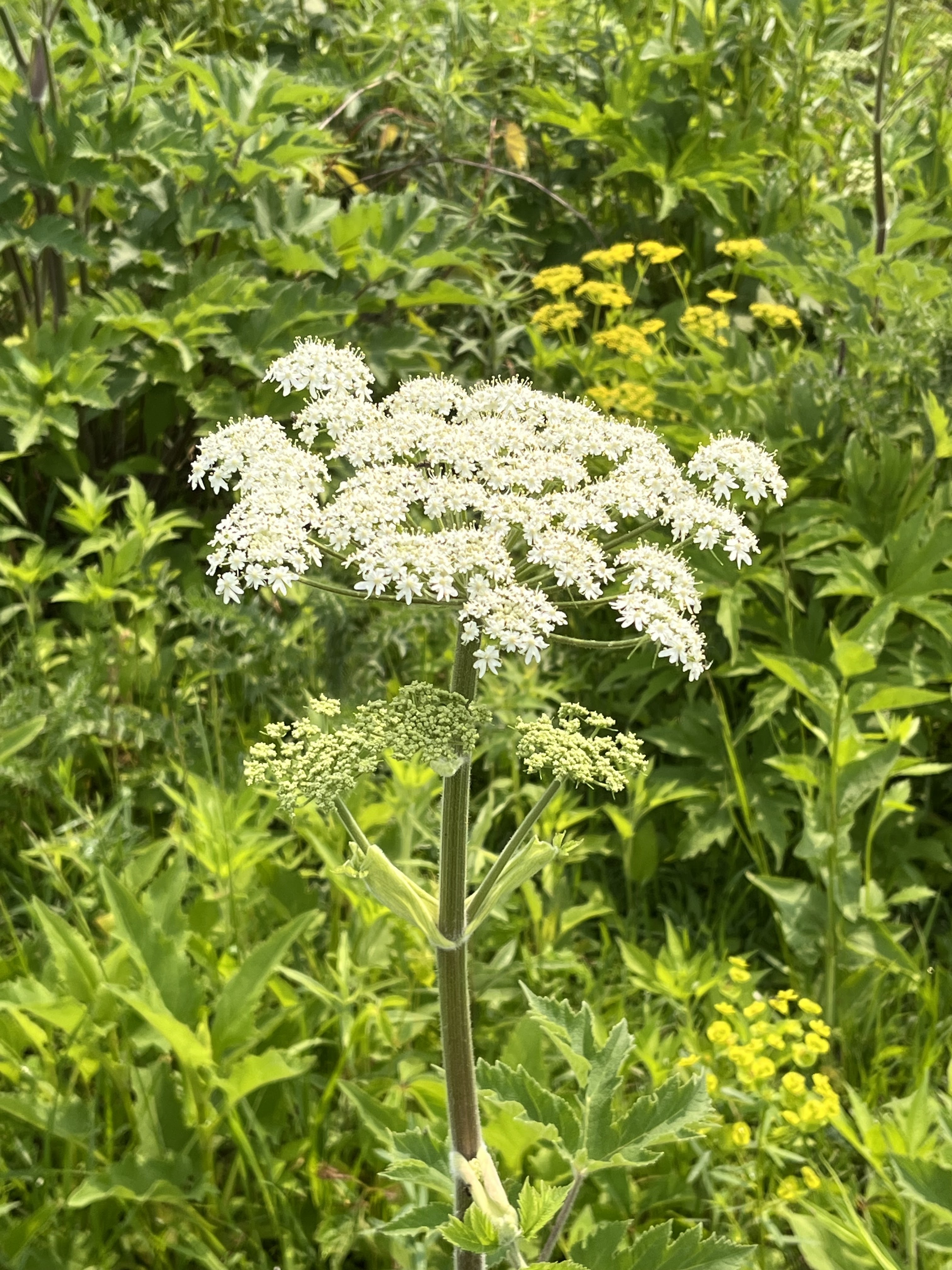
Cow parsnip, or Heracleum maximum, is a wildflower native to North America, including Wisconsin. It can reach heights of 4 to 10 feet. It bears large, flat-topped clusters of small white flowers, with each cluster—or umbel—spanning 4 to 12 inches across. Each tiny flower is about a quarter inch wide, with larger ones often framing the edges of the cluster in a lacy display. Its leaves are massive and divided into three parts, with the largest basal leaves stretching up to 18 inches long and wide; their surfaces are softly hairy and toothed at the edges. The stem is thick, hollow, ridged, and covered in fine white hairs, measuring up to 2 inches in diameter. This plant thrives in full sun to partial shade and prefers moist soils, commonly growing along streambanks, forest edges, and damp meadows. While striking, cow parsnip contains sap that can irritate the skin when exposed to sunlight—making it beautiful but best admired at a respectful distance. Beyond its striking appearance, cow parsnip plays a key ecological role by supporting pollinators such as bees, butterflies, and beetles with its abundant nectar and pollen. (LS)


Sessile-leaf Bellwort (Uvularia sessilifolia)


Sessile-leaf bellwort is a delicate woodland wildflower that grows between 4 to 12 inches tall. It produces drooping, pale yellow flowers about an inch long, with six slightly curved petals. The plant's leaves are up to 3 inches long and 1 inch wide, attaching directly to the stem without stalks, while the main stem forks near the top, giving it a distinctive zig-zag growth pattern. The lower stem is sheathed, and as it matures, the upper portion takes on a reddish-purple hue. This species thrives in moist, rich, acidic soils with good drainage and prefers shade to partial shade. It naturally spreads through underground stolons, making it well suited to shaded forests and thickets where it forms small colonies in undisturbed areas. (LS)


American Fly Honeysuckle (Lonicera canadensis)


American fly honeysuckle is a flowering, deciduous shrub that typically reaches a height of 24 to 72 inches. Its light yellow, tubular flowers bloom in late spring, appearing in pairs and measuring about ½ to ¾ inch long. The leaves are simple, light green, and range from 1½ to 3½ inches in length, growing in opposite pairs along the branches. The shrub’s stems are loosely branched, with light brown to brownish-gray bark, while its twigs can vary from green to purplish. This honeysuckle thrives in moist, well-drained soils but can tolerate rocky or gravelly conditions. It prefers partial shade to full sun, making it adaptable to different environments. It is commonly found in shady woodlands, stream banks, forest edges, and rich understory areas. (LS)
 

Seneca Snakeroot (Polygala senega)


Seneca snakeroot, or Polygala senega, is a perennial herb that grows between 10 to 18 inches tall. Its flowers are arranged in spike-like racemes at the tip of the stem, with each flower measuring about 1/6 inch long and featuring white to greenish-white petals with a fringed crest. The leaves range from 1 to 3 inches long and 1/3 to 1 1/3 inch wide, appearing linear to lance-elliptic and widest at or below the middle, with a hairless or minutely hairy surface. This plant thrives in full or partial sun and prefers dry to mesic conditions with sandy or rocky soil. Seneca snakeroot is commonly found in prairies, stream banks, and woodland openings, particularly in areas with well-drained soils.

Senega snakeroot has traditionally been used as a cure for snakebite by native Americans.  It was used for earaches, toothaches, sore throats, croup and colds. Its main use today is as an expectorant in cough syrups, teas and lozenges, and as a gargle for sore throats. It has also been used in larger doses as an emetic and cathartic. To propagate from seed requires cold stratification for 60 days before planting, and shows a 60 - 80 percent germination rate. It can also be propagated from cuttings. (LS)

Shining Lady’s Tresses (Spiranthes lucida)


Photo by Jeff Nesta

Spiranthes lucida,  commonly known as shining lady’s tresses, is a perennial orchid native to northeastern North America, including Wisconsin. It typically grows up to 15 inches tall and produces white flowers in a spiral arrangement along a single spike, each featuring a yellow lip. The basal leaves are lance-oblong and remain during flowering.

The species blooms from late May and fruits by mid-Summer. It inhabits saturated, calcareous soils in places such as streambanks, fens, river terraces, and old quarries. Its range extends from Nova Scotia to northeastern Wisconsin, and south to Virginia, Arkansas, and Missouri.

Pollination is primarily carried out by short-tongued bees, particularly from the Halictidae family. In some regions, including Wisconsin, it is listed as a species of special concern due to habitat sensitivity.  (LS)

Wood Nettle (Laportea canadensis)


I did my masters thesis on Laportea - one thing I found (but did not publish unfortunately) is that it correlates with spring ephemerals. It comes up later so they can do their thing before it shades them put.  It out-competes the plants that come up earlier and DO compete with the ephemerals.

Photo by Gary Kurtz

Unloved but Essential: Embracing Unpopular Plants for Biodiversity

From the tangled underbrush of Wisconsin’s forests, we find Laportea canadensis, or wood nettle--a plant more likely to earn a curse than a compliment thanks to its stinging hairs. Yet for all its prickly nature, wood nettle is a quiet cornerstone of healthy forest ecosystems: anchoring soil, nurturing wildlife, and helping extend biodiversity.

In the world of landscaping, a plant’s worth is often judged by aesthetics—showy blooms, tidy habits, or ease of maintenance. But native plants like wood nettle, often labeled as weeds, provide irreplaceable ecological benefits. Their presence fosters layered habitats, supports native insects, and helps reduce the impact of environmental stress.

Wood nettle thrives in shaded, moist areas of Wisconsin’s forests and wetlands, where it often forms dense patches in low-lying hardwood stands and along streambanks. It typically grows two to four feet tall with leaves up to six inches long, featuring serrated edges and stinging hairs that serve as a natural defense. Its tiny greenish-white flowers, though unassuming, play their part in forest reproduction through separate male and female blooms. Most importantly, this plant stabilizes soil, prevents erosion, and offers food and shelter to countless insects and small animals.

It’s easy to overlook plants like this—too prickly, too plain, too wild for conventional garden appeal. But wood nettle is emblematic of an urgent truth: biodiversity depends on diversity, not just of color or form, but of function. These underappreciated species support webs of life that charismatic flowers alone cannot sustain.

By rethinking our private landscapes—through practices like meadowscaping—we can move beyond manicured monocultures and embrace complexity. Incorporating native species, including the “unpopular” ones, transforms sterile turf into rich habitat. When we welcome plants like wood nettle into our yards, we aren't just tolerating the wild—we’re restoring it. (LS)

Annual Fleabane (Erigeron annus)


  Photo by Gary Kurtz

Annual Fleabane, scientifically known as Erigeron annuus, is a native wildflower in Wisconsin that thrives in disturbed areas such as pastures, abandoned fields, roadsides, and railways. This adaptable plant grows between one and five feet tall, producing delicate aster-like flowers in the spring. Each flower features a bright yellow center composed of tubular disk florets, surrounded by 80 to 125 narrow rays that range in color from white to pale lavender. The flowers, measuring about half an inch to one inch in diameter, create a soft, airy appearance that adds charm to natural landscapes.

The foliage of Annual Fleabane is equally distinctive. Its leaves are alternate and sessile, meaning they lack a stalk and attach directly to the stem. The lower leaves, which are broader and coarsely toothed, typically grow between two and four inches long and up to two inches wide. In contrast, the upper leaves are narrower, often without teeth, and can reach up to five inches in length. The plant’s green stems are sparsely hairy, contributing to its slightly rough texture.

In Wisconsin, Annual Fleabane plays an important role in both gardens and ecological restoration projects. Its ability to thrive in disturbed soils makes it a valuable pioneer species, helping to stabilize and enrich degraded landscapes. It is often one of the first native plants to return to areas undergoing restoration, outcompeting invasive species and supporting local biodiversity. The flowers attract a variety of pollinators, including bees, butterflies, and small wasps, making it a beneficial addition to pollinator gardens. Additionally, its presence in naturalized areas contributes to habitat restoration efforts, providing food and shelter for insects and other wildlife. Whether growing in wild spaces or incorporated into native plant gardens, Annual Fleabane enhances the environment with its resilience and ecological benefits. (LS) 

Foxglove Beardtongue (Penstemon digitalis)


Photo by Gary Kurtz
   

Foxglove beardtongue (Penstemon digitalis) is a hardy perennial wildflower native to the eastern North America, and can be found naturalized throughout Wisconsin. It grows to a height of three to five feet, producing clusters of delicate white to pale pink flowers that are tubular and two-lipped, resembling foxgloves. These blossoms attract a variety of pollinators, including bees, butterflies, and hummingbirds, making the plant a valuable addition to pollinator gardens. Its deep green, lance-shaped leaves grow in opposite pairs along the stem, with basal leaves forming a rosette. Foxglove beardtongue thrives in a range of habitats, such as prairies, meadows, woodland edges, fields, and disturbed areas like roadsides and powerline corridors. It prefers full sun to partial shade and well-drained soils, making it an ideal choice for both natural landscapes and cultivated gardens.

In Wisconsin, this wildflower plays an important role in gardens and ecological restoration projects. Its adaptability and low maintenance requirements make it a popular choice for native plant gardens, where it provides seasonal interest and supports local biodiversity. Because it is drought-tolerant and capable of growing in a variety of soil conditions, foxglove beardtongue is often used in prairie restoration efforts to help reestablish native plant communities. Its deep root system stabilizes soil, making it useful for erosion control in areas where soil disturbance is a concern. (LS)

Carolina Rose (Rosa carolina)


 Photo by Gary Kurtz

Carolina Rose

Rosa carolina, commonly known as Carolina rose or pasture rose, is a deciduous shrub that typically grows 1 to 3 feet tall, occasionally reaching up to 6 feet, and spreads 1 to 5 feet wide. It produces fragrant pink flowers, usually borne singly—or on twos or threes—rather than in clusters, with blooms measuring 2-1/2 to 3 inches in diameter. The stems are upright and armed with straight, needle-like thorns. Its smooth, dark green foliage consists of compound leaves that turn yellow to red in the fall. This hardy native thrives in a wide range of habitats—from dry prairies and open woods to moist streambanks and roadsides—and is tolerant of heat and occasional drought once established. It also spreads by suckers, forming thickets that provide excellent cover and food for wildlife.

In Wisconsin, Carolina rose is valued for its role in both gardens and ecological restoration projects. Its adaptability makes it a popular choice for native plant gardens, where it provides seasonal beauty and supports local wildlife. The flowers attract pollinators such as bees and butterflies, while the dense foliage offers shelter for small animals. In prairie restoration efforts, Carolina rose helps stabilize soil and reintroduce native plant diversity to degraded landscapes.  (LS)


Ohio Spiderwort (Tradescantia ohiensis)


Ohio Spiderwort (Tradescantia ohiensis)

Ohio spiderwort is a wildflower native to Wisconsin. It will start bloomng later n May. It grows one to three feet tall. Its flowers have three petals and six hairy yellow-tipped stamens. The flowers can be blue to purple, sometimes pink or nearly white. They grow in terminal clusters of up to 20 at the top of erect stems with long, slender, leaf-like bracts below each cluster. The leaves are long, narrow, and grass-like. They grow in a clump at the base of the stem and are eight to 16 inches long and less than an inch wide. It grows best in sunny, moist, well drained areas, but is highly adaptable. (LS)

Indian Paintbrush (Castilleja coccinea)


Photo by Carla Wells

Indian paintbrush (Castilleja coccinea) is a striking native wildflower found in Wisconsin and across much of the eastern and central United States. This annual plant reaches a height of one to two feet, standing tall with its distinctively hairy single stem.

Its flowers, though greenish yellow and only about an inch long, are the main attraction. What catches the eye are the vivid red-tipped bracts—specialized leaf-like structures—that cluster together, creating the illusion of a brilliant bloom. These three-lobed bracts contrast beautifully with the plant’s nearly clasping alternate leaves, typically divided into three narrow, finger-like lobes.

Indian paintbrush thrives in moist environments, often appearing in open fields, prairies, and rocky outcroppings. Interestingly, it's a hemiparasitic plant, meaning it taps into the roots of nearby grasses and other plants for nutrients while still producing its own food through photosynthesis. (LS)

Bunchberry Dogwood (Cornus canadensis)


Photo by Jan Tezlaff

Bunchberry dogwood (Cornus canadensis) is a low-growing perennial native to northern North America, including Wisconsin, as well as much of Canada and parts of the northeastern United States. This resilient plant thrives in cool, damp, and shady woodlands, often found beneath towering trees and shrubs.

Typically reaching just six to nine inches in height, bunchberry dogwood forms a dense, ground-covering mat. Its delicate flowers, only a few millimeters in diameter, bloom in late spring to early summer. These tiny blossoms feature creamy white, star-shaped petals. The short-stalked leaves measure around three inches long and two inches wide, with a distinct wedge-shaped base and abruptly pointed tips. A key characteristic of bunchberry dogwood is its veining—unlike many plants, its veins curve outward toward the leaf tip.

Bunchberry dogwood plays an essential role in forest ecosystems, providing food for wildlife. In late summer, clusters of bright red berries appear, which serve as a food source for birds and small mammals. Additionally, this native plant holds value as a garden addition, particularly in shaded landscapes. Its ability to spread and form a dense carpet makes it an excellent ground cover for woodland gardens, while its delicate flowers and vibrant berries contribute to its ornamental appeal.
(LS)

Large-flowered Beardtongue (Penstemon grandiflorus)


     Large-flowered Beardtongue is a native, perennial wildflower in Wisconsin. It grows from one to 3-1/2 feet tall. The tubular flowers are pink to lavender and arranged horizontally in upright racemes. Each flower is about two inches long. The leaves are blue-gray or blue-green with smooth margins. The leaves have a succulent appearance and decrease in size as you move up the stem. The leaves can be up to six inches long in the first year. This plant enjoys well drained, sandy or gravelly soil in prairies, open woodlands, and along roadsides. (LS)

Star Flower (Trientalis borealis)


Starflower (Trientalis borealis) is a native perennial wildflower found in Wisconsin and much of the northeastern United States. It thrives in wet conifer and deciduous forests, where its slender stems and elegant blooms add a subtle beauty to the woodland floor. Growing between four and eight inches tall, starflower is a small but striking presence in shaded environments.

The flowers of starflower are distinctive, typically appearing as one or two star-shaped, white blossoms that sit atop delicate stalks above the leaves. Each flower measures about half an inch wide and features seven sharply pointed petals, giving it a unique symmetry. The leaves are arranged in a whorl of five to seven and are lance-shaped, forming a graceful backdrop to the blooms.

Additionally, starflower plays an important ecological role. It provides nectar for native bees and other pollinators, supporting biodiversity in forested habitats. The plant spreads through underground rhizomes, allowing it to form small colonies that help stabilize soil and prevent erosion. Its presence in rich, moist woodlands contributes to the overall health of the ecosystem.

In garden settings, starflower can be a good addition to shaded landscapes. It thrives in acidic, well-drained soils and prefers dappled light, making it well-suited for woodland gardens. While it is not commonly cultivated on a large scale, it can be grown from seed or transplanted from nursery stock. Once established, it requires minimal maintenance and adds a naturalistic touch to shaded areas. (LS)


White Wild Indigo (Baptisia alba)


White Wild Indigo

White wild indigo (Baptisia alba) is a native perennial wildflower found in Wisconsin and throughout much of the central and eastern United States. This hardy plant grows three to four feet tall, with tall, erect stems that support long spikes of pea-shaped flowers resembling lupine. Each individual flower is about an inch long, creating a showy display that attracts pollinators and brightens prairies, open woodlands, and roadsides.

The foliage of white wild indigo is equally distinctive. Its bluish-green compound leaves are divided into three leaflets, each ranging from two to four inches in length. This unique leaf structure contributes to the plant’s ability to withstand drought and poor soil conditions, making it a resilient addition to natural landscapes.

Additionally, white wild indigo plays an essential ecological role. As a member of the legume family, it helps improve soil health by fixing nitrogen, enriching the surrounding environment for other plants. It is also a valuable nectar source for bees, butterflies, and other pollinators, supporting biodiversity in prairie ecosystems. Plus, the plant serves as a host for the larvae of the wild indigo duskywing butterfly.

In garden settings, white wild indigo is a fantastic choice for those looking to cultivate native plants. It thrives in full sun to partial shade and adapts well to a variety of soil types, including clay and sandy soils. Once established, it requires minimal maintenance, as it is highly resistant to drought, deer, and disease. Its deep root system makes it an excellent choice for erosion control, particularly in prairie restorations and roadside plantings. (LS)

Canada Mayflower (Maianthemum canadense)


Canada Mayflower 

Canada mayflower (Maianthemum canadense) is a delicate, native perennial wildflower found in Wisconsin and much of the northeastern United States. This small plant, reaching only three to five inches in height, thrives in cool temperatures and moist soils, making it a common sight in damp, mossy wooded areas and rich forests. It prefers shade or part shade, often flourishing under the protective canopy of trees.

The flowers of Canada mayflower are tiny and star-shaped.Typically, each bloom consists of two petals and two sepals, which are often white or cream-colored. Their arrangement gives the appearance of a tiny bell. The leaves are simple and alternate along the stem, oval or elliptical in shape, and range from two to four inches in length. Each node on the stem produces a single leaf, creating a distinctive pattern.

Beyond this, Canada mayflower plays an important ecological role. It spreads through underground rhizomes, forming dense colonies that help stabilize forest soils and prevent erosion. The plant also provides food for various wildlife species. Its berries, which transition from green to a dull red with white speckles, are consumed by birds and small mammals, including ruffed grouse, mice, and chipmunks. 

Canada mayflower is also valuable in garden settings, particularly for those looking to cultivate native plants. It serves as an excellent groundcover for shaded areas, adapting well to a variety of soil types. Because it spreads by rhizomes, it can create a lush, low-growing carpet in woodland gardens. Its ability to thrive in both moist and dry conditions makes it a versatile choice for gardeners seeking to enhance biodiversity while maintaining a natural aesthetic. (LS)

Gaywings (Polygaloides paucifolia)


Photo by Judith Kozminski

    Gaywings, also known as Fringed Polygala,(Polygaloides paucifolia) is  a wildflower native to Wisconsin and much of the northeastern United States. It is a perennial plant that thrives in dry to moist conifer forests, often under pines, and prefers part shade to shade. It is a small plant, reaching only three to seven inches in height. Each plant produces one to four deep pink to nearly white blossoms, each less than an inch wide. The flowers have two oval sepals that resemble petals and flare out like wings, giving them their distinctive appearance. The leaves are crowded toward the tip of the stem, elliptic in shape, with toothless edges that are often fringed with short hairs. Their bloom time is typically in the spring to early summer, adding a splash of color to the forest floor.

In addition to attracting pollinators with their nectar, gaywings play another important ecological role. Like many spring wildflowers, they rely on ants for seed dispersal, a strategy known as myrmecochory. Their seeds have nutrient-rich attachments called elaiosomes that attract ants, which then carry the seeds into their nests. The ants consume the elaiosomes, leaving the seeds to germinate underground, far from the parent plant. This process helps maintain genetic diversity and ensures the continued spread of the species.

They can also be successfully grown in shade gardens. They thrive in acidic, well-drained, organic soils and do best when planted without competition from aggressive species. Their slow-growing, semi-evergreen nature makes them an excellent groundcover for woodland gardens.  (LS)

Smooth Sweet Cicely (Osmorhiza longistylis)


Smooth Sweet Cicely

Smooth sweet cicely (Osmorhiza glabrata) is a native, perennial wildflower in Wisconsin, typically reaching heights of one to three feet. It produces small, white flowers about 1/8 inch wide, which are arranged in flat clusters (umbels) at the top of the plant and along branching stems. Each flower consists of five white petals, five white-tipped stamens, and two elongated white styles that exceed the length of the petals. The leaves are lush, fern-like, and compound, measuring three to six inches in length. They are divided into three parts, with each section further subdivided into smaller segments, creating an intricate and delicate appearance. This plant thrives in rich woods and wooded slopes, preferring moist, well-drained soil with shade to partial shade, and it serves as an important food source for pollinators such as bees, flies, wasps, and moths.

Smooth sweet cicely favors soil that is neutral to slightly alkaline, though it can tolerate a pH range of 6.0 to 7.0. Consistent moisture is crucial for its health, but excessive wetness should be avoided. It propagates mainly through seeds, which take anywhere from 14 to 30 days to germinate depending on soil conditions. Division of established plants is another effective propagation method, typically performed in early spring or fall. While stem cuttings are sometimes used for propagation, they are far less reliable than seeds or division. When planting, seeds should be placed one to two inches deep and spaced 12 to 18 inches apart to allow for proper growth and airflow. The plant has a lifespan of three to five years, making it a dependable addition to gardens where its delicate, anise-like fragrance and medicinal qualities can be appreciated. Light fertilization in early spring promotes healthy development, and its adaptability to shaded landscapes makes it a valuable choice for naturalistic plantings and pollinator support. (LS)