
Table of Contents

Snow Trillium (Trillium nivale)
Photo by Jeff Nesta
Snow trillium (Trillium nivale), a threatened wildflower in Wisconsin, blooms from late March through late April, making it one of the very first spring ephemerals to appear—often while snow is still on the ground. It typically grows to a height of 3 to 6 inches. Its single flower, measuring up to 2 inches across, features three elegant white tepals—structures that combine the characteristics of petals and sepals—alongside three green sepals and six yellow stamens. Below the bloom, three olive green or green leaves are arranged in a whorl, each up to 2 inches long and 1-1/4 inches wide. Snow trillium prefers filtered sunlight during the spring, before the trees leaf out, and light shade during the summer. It also likes loamy or rocky mesic to dry soil enriched with decaying leaf matter. It is commonly found in rich woodlands, thinly wooded bluffs, and upper riverbanks.
Sources:
Wisconsin Department of Natural Resources — Snow Trillium species profile
USDA Plants Database — Trillium nivale
Illinois Wildflowers — Snow Trillium overview
Flora of North America — Trillium nivale botanical description
NatureServe Explorer — Conservation status for Trillium nivale
(EW)

Field Thistle (Cirsium discolor)


Cup Plant (Silphium perfoliatum)
Cup plant is a strong supporter of prairie biodiversity. Its water-holding leaf cups and seeds draw in birds, while its abundant nectar and pollen support a wide array of native bees, butterflies, and beetles. The plant’s sturdy stems and late-season blooms provide critical structure and forage in restored prairies, wetlands, and riparian buffers. As a deep-rooted perennial, it also contributes to soil stabilization and carbon sequestration, making it a valuable ally in ecological restoration and climate resilience.
Cup plant is a native of eastern North America, including Wisconsin. It usually grows six to eight feet tall, bearing numerous two to three-inch, yellow flowers. Each flower head has 20 to 30 yellow rays and darker yellow disks. Leaves often more than ten inches long are joined at the stem to form a small cup. Cup plant thrives in moist, well‑drained soils along prairie edges, stream corridors, and floodplain openings, doing best in full sun but tolerating partial shade.
Sources:
Prairie Moon Nursery — Silphium perfoliatum
USDA PLANTS Database — Silphium perfoliatum
Flora of North America — Silphium perfoliatum
Illinois Wildflowers — Cup Plant
Wisconsin State Herbarium — Silphium perfoliatum
Meadow Blazing Star (Liatris ligulistylis)
Meadow blazing star (Liatris ligulistylis) is a tall, showy prairie perennial, usually two to five feet high on slender, erect stems that may be green to reddish and lightly hairy. Its flower heads are one to about one and a quarter inches wide, each composed of thirty to one hundred pinkish‑purple disc florets. These heads form a loose raceme along the upper stem, giving the plant its feathery, thistle‑like appearance. Leaves are alternate and lance‑shaped, four to eight inches long and up to one and a half inches wide, with sparse white hairs and a smooth texture. Basal leaves are larger and more oblanceolate; upper leaves narrow and become sessile.
Meadow blazing star thrives in full sun and well‑drained soils—especially sandy, loamy, or rocky substrates. It is most common in prairies, meadows, and streambanks across the Midwest. Its nectar‑rich flowers are especially attractive to monarchs during late‑summer migration.
Source‑title list
Flora of North America – Liatris ligulistylis
USDA Plants Database – Liatris ligulistylis
Illinois Wildflowers – Meadow Blazing Star
Minnesota Wildflowers – Meadow Blazing Star
(SF)

Purple giant hyssop (Agastache scrophulariifolia) is a tall, native mint‑family perennial of eastern North America, usually reaching four to six feet. It grows in upright clumps on square stems that may show purplish tones and light hair. The flower spikes range from one to six inches long and carry many small tubular blossoms in pale purple to lavender. Each flower has a two‑lobed upper lip, a three‑lobed lower lip, and four stamens that extend beyond the corolla. Leaves are opposite, sharply pointed, and borne on short stalks. They are up to four inches long and two inches wide, with coarsely toothed margins and short hairs on the petioles.
Purple giant hyssop favors moist, sandy or loamy soils in partial shade. It grows along woodland edges, in thickets, upland woods, and disturbed floodplain margins. Because it is sensitive to competition, it often persists where light disturbance keeps surrounding vegetation open.
Source‑title list
Flora of North America – Agastache scrophulariifolia
USDA Plants Database – Agastache scrophulariifolia
Illinois Wildflowers – Purple Giant Hyssop
Minnesota Wildflowers – Purple Giant Hyssop
(SF)


Thinleaf Sunflower (Helianthus decapetalus)
Thinleaf sunflower (Helianthus decapetalus) is a native perennial of eastern and central North America, including Wisconsin. It usually grows three to six feet tall and often forms loose colonies through its rhizomes. The bright yellow flower heads are two to three inches across, each with eight to twelve rays around a brownish central disk. They appear in open clusters from late summer into early fall and draw a wide mix of pollinators.
The leaves are thin‑textured, lanceolate to ovate, and rough to the touch. They range from three to six inches long and one to three inches wide. Upper leaves are mostly opposite; lower leaves may shift to alternate. Stems are slender, smooth or lightly hairy, and branch near the top. Thinleaf sunflower favors partial shade to dappled sun and grows best in moist, well‑drained soils along woodland edges, thickets, and shaded slopes. Its late‑season bloom and colony‑forming habit make it a steady contributor to pollinator support in naturalistic plantings and restoration work.
Sources:
Flora of North America – Helianthus decapetalus
USDA Plants Database – Helianthus decapetalus
Illinois Wildflowers – Thinleaf Sunflower
Minnesota Wildflowers – Helianthus decapetalus
(SF)


Harebell (Campanula rotundifolia)
Sometimes mistaken for creeping bellflower, harebell is a native perennial wildflower found in Wisconsin and across much of North America. It thrives in a variety of open or lightly shaded environments, including rocky outcroppings along rivers, meadows, and prairies. It prefers well-drained soils. Despite its fragile appearance, harebell is well-adapted to dry, sandy, and gravelly soils, making it a common sight in rugged landscapes. It is resistant to deer and drought. Its long blooming period, from late spring to early autumn, ensures a continuous display of delicate flowers throughout the growing season.
It grows up to 20 inches tall, with thin, wiry stems that support its nodding, bell-shaped flowers. Each flower is less than an inch long and consists of five fused petals, forming a soft, pale bloom. The basal leaves, withering by flowering time, are round, measuring between half an inch to one inch wide, while the upper leaves are grass-like, reaching about three inches in length and only 1/8 to 1/4 inch wide. These leaves alternate along the stem, contributing to the plant’s airy and delicate structure.
Harebell’s historical and cultural significance adds to its charm. In folklore, it has been associated with fairies and enchantment, earning names such as "witch’s thimble" and "bluebell of Scotland." Despite its whimsical reputation, it remains a tough and adaptable plant, capable of thriving in challenging conditions.
Sources:
USDA Plants Database — Campanula rotundifolia
Lady Bird Johnson Wildflower Center — Campanula rotundifolia Profile
Illinois Wildflowers — Harebell
Minnesota Wildflowers — Harebell
Flora of North America — Campanula rotundifolia
Wisconsin State Herbarium — Campanula rotundifolia
(LS)

Purplestem Angelica (Angelica atropururea)
Purple-stemmed Angelica is a perennial native to eastern and central North America—including Wisconsin. It can grow up to ten feet tall with most plants in the four to eight foot range. Its flowers are small, only about a quarter inch across, but they bloom in large umbrella-like clusters called umbels that span 8 to 10 inches wide. The flowers are typically white to greenish-white and bloom from late spring into summer. The leaves are compound and can reach up to 24 inches in both length and width. Each leaflet grows to about 4.5 inches long and 2.5 inches wide, with a toothed, oval to lance-oval shape. The stems are hollow, smooth, and purple. They are typically 1 to 2 inches thick. Purple-stemmed Angelica prefers moist to wet, nutrient‑rich soils, with a slightly acidic to neutral pH. It thrives in sunny marshes, wet meadows, and along streambanks, especially where the soil has some lime content, but can survive in partial shade.
Ecologically, purple angelica—as a member of the carrot family—plays a valuable role in supporting biodiversity. Like many other Apiaceae species, it features umbels of flowers that are especially attractive to a wide range of pollinators, including bees and flies. While specific larval host associations for purple angelica remain under-documented, related species in the family are known to support caterpillars of butterflies and moths. By offering nectar, pollen, and shelter, purple angelica contributes to the ecological richness of the wetland environments where it thrives.
Sources:
USDA PLANTS Database — Angelica atropurpurea species profile
Minnesota Wildflowers — Angelica atropurpurea (Purple‑stemmed Angelica)
Illinois Wildflowers — Purple‑stemmed Angelica (Angelica atropurpurea)
Flora of North America — Angelica atropurpurea botanical description
Michigan Flora / University of Michigan — Angelica atropurpurea account
NatureServe Explorer — Angelica atropurpurea conservation status and distribution
UW–Madison Division of Extension — Native wetland plants of Wisconsin
(LS)
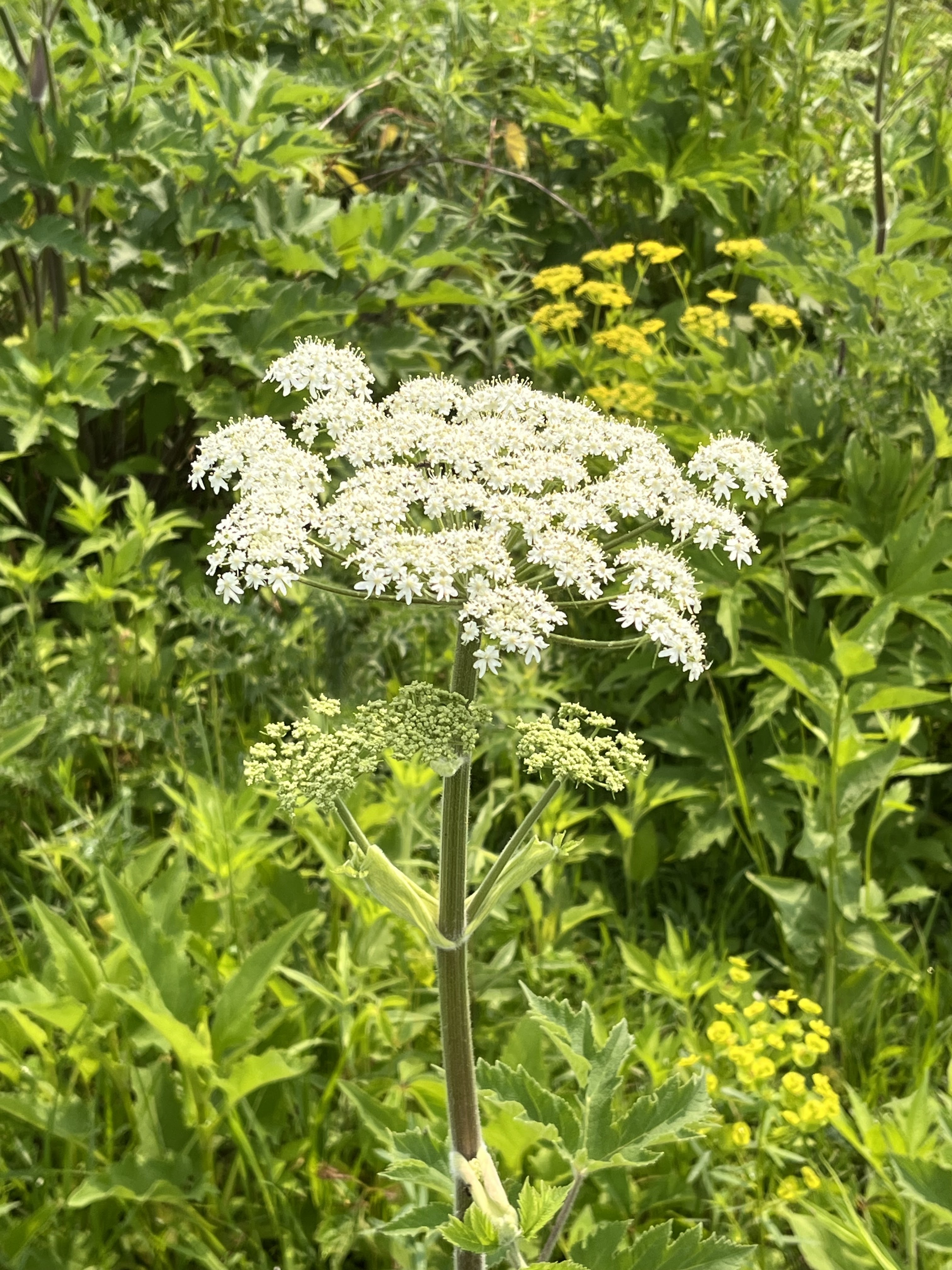
Cow Parsnip (Heracleum maximum)
Cow parsnip (Heracleum maximum) is a tall, native wildflower found across North America, including Wisconsin. It typically grows 4 to 10 feet tall and bears broad, flat‑topped compound umbels of small white flowers, each umbel spanning 4 to 12 inches across. Individual flowers are about a quarter inch wide, with larger, showier blossoms often forming a lacy ring around the edge. The leaves are enormous and divided into three large lobes or leaflets, with basal leaves reaching up to 18 inches long and wide; their surfaces are softly hairy and coarsely toothed. The stem is thick, hollow, ridged, and covered in fine white hairs, sometimes approaching 2 inches in diameter. Cow parsnip thrives in full sun to partial shade in moist, nutrient‑rich soils, especially along streambanks, forest edges, wet meadows, and cool alluvial flats. Its sap contains furanocoumarins that can cause skin irritation when exposed to sunlight, making it a plant best admired without handling. Ecologically, cow parsnip is an important summer nectar source, supporting a wide range of pollinators—including bees, flies, beetles, and butterflies—drawn to its abundant, accessible umbels.
Sources:
USDA PLANTS Database — Heracleum maximum species profile
Minnesota Wildflowers — Heracleum maximum (Cow Parsnip)
Illinois Wildflowers — Cow Parsnip (Heracleum maximum)
Flora of North America — Heracleum maximum botanical description
Michigan Flora / University of Michigan — Heracleum maximum account
NatureServe Explorer — Heracleum maximum conservation status and distribution
UW–Madison Division of Extension — Native wetland and riparian plants of Wisconsin
(LS)
 |
Minnesota Wildflowers — Uvularia sessilifolia (Sessile‑leaf Bellwort)
Illinois Wildflowers — Sessile‑leaf Bellwort (Uvularia sessilifolia)
Flora of North America — Uvularia sessilifolia botanical description
Michigan Flora / University of Michigan — Uvularia sessilifolia account
NatureServe Explorer — Uvularia sessilifolia conservation status and distribution
UW–Madison Division of Extension — Spring woodland wildflowers of Wisconsin

Minnesota Wildflowers — Lonicera canadensis (American Fly Honeysuckle)
Illinois Wildflowers — American Fly Honeysuckle (Lonicera canadensis)
Flora of North America — Lonicera canadensis botanical description
Michigan Flora / University of Michigan — Lonicera canadensis account
NatureServe Explorer — Lonicera canadensis conservation status and distribution
UW–Madison Division of Extension — Native woodland shrubs of Wisconsin

This species grows in full to partial sun and favors dry to mesic, well‑drained soils—especially sandy, gravelly, or rocky substrates. In Wisconsin it is found in prairies, savannas, open woodlands, and dry, rocky stream margins or slopes. Its presence often signals intact, undisturbed native plant communities.
Sources:
USDA PLANTS Database — Polygala senega species profile
Minnesota Wildflowers — Polygala senega (Seneca Snakeroot)
Illinois Wildflowers — Seneca Snakeroot (Polygala senega)
Flora of North America — Polygala senega botanical description
Michigan Flora / University of Michigan — Polygala senega account
NatureServe Explorer — Polygala senega conservation status and distribution
UW–Madison Division of Extension — Dry prairie and savanna species of Wisconsin

Minnesota Wildflowers — Spiranthes lucida (Shining Lady’s Tresses)
Illinois Wildflowers — Shining Lady’s Tresses (Spiranthes lucida)
Flora of North America — Spiranthes lucida botanical description
Michigan Flora / University of Michigan — Spiranthes lucida account
NatureServe Explorer — Spiranthes lucida conservation status and distribution
UW–Madison Division of Extension — Calcareous fen and groundwater‑dependent plant species


Canadian Goldenrod (Solidago canadensis)
Canadian goldenrod is a herbaceous perennial that usually grows two to five feet tall, sometimes reaching six feet in richer soils or sheltered edges. The stems are erect and generally hairy, though the lower portions can be less so. Even with those hairs, the stem feels smooth in the hand. When you run your fingers upward, it has a firm, even surface rather than the gritty drag found on tall goldenrod. The upper leaf surface behaves the same way. It may be a little rough from short hairs, but it isn’t abrasive. That smooth‑to‑lightly‑textured feel is one of the most reliable cues for Canada goldenrod in southern Wisconsin, holding steady across subspecies, soil types, and weather.
The flowering panicles are large, plume‑like, and often more than five inches long. Small yellow flower heads line the arching branches, giving the plant its familiar sweeping shape. Bloom time runs from late summer into early fall, and the species draws a wide range of pollinators — native bees, butterflies, beetles, and wasps.
Leaves are alternate, lanceolate to narrowly lanceolate, typically three to six inches long and up to an inch wide. Margins are sharply serrated. The upper surface is usually roughened by short hairs, while the underside is paler and may be sparsely hairy. Leaf hairiness varies among subspecies, which explains why some guides describe the underside differently. Even so, the tactile cue remains consistent: the leaves feel firm but not gritty.
Canadian goldenrod grows in many soil types but is most common in medium‑texture soils with moderate organic matter. It thrives in full sun and tolerates mesic to moderately dry conditions. You’ll find it in prairies, old fields, roadsides, rail corridors, and open meadows. It does occur along waterways, but it is not a species of consistently wet ground — that role belongs more to Solidago gigantea.
Sources:
Illinois Wildflowers – Solidago canadensis
Flora of North America – Solidago canadensis
USDA Plants Database – Solidago canadensis
Minnesota Wildflowers – Canada Goldenrod
(SF)
