Showing posts sorted by relevance for query SF. Sort by date Show all posts

Common Boneset (Eupatorium perfoliatum)


Common Boneset (Eupatorium perfoliatum)

Boneset thrives in the margins of wetlands and woodland edges. This native perennial, common across Wisconsin, grows to about four feet tall and bears clusters of small, white, tubular flowers that bloom in late summer, arranged in flat-topped arrays at the tips of its stems. Its leaves grow in opposite pairs, their finely toothed edges and joined bases forming a green collar around the stem. Lower down, the leaves broaden—reaching up to eight inches long and two inches wide—catching light and moisture in the shaded understory. Though modest in appearance, boneset is a lifeline for late-season pollinators: bees, butterflies, moths, and hummingbirds gather at its nectar-rich blooms. Goldfinches and swamp sparrows feed on its seeds, while the foliage nourishes caterpillars of several moth species. It thrives not only in wetlands and woodland edges, but also in marshes, swales, and along streams, tolerating both sun and shade. With fibrous roots and rhizomes that allow it to form small colonies, boneset helps stabilize soil and anchor damp habitats. (SF)


Virgin’s Bower (Clematis virginiana)


Virgin’s Bower  (Clematis virginiana)

Virgin’s bower is a vigorous native vine that plays an important role in Wisconsin’s moist woodlands and streamside habitats. Its fragrant late-summer blooms support bees, butterflies, and other pollinators when few other natives are flowering, while its dense foliage offers nesting cover for songbirds and erosion control along banks. As a host plant for specialist insects like the Clematis Clearwing Moth, it contributes to complex food webs, even attracting beneficial parasitic wasps. Though its foliage is avoided by mammals, such as deer and rabbits, its adaptability and fast growth make it a valuable addition to restoration projects, especially when paired with other moisture-loving natives.

It can grow up to 20 feet tall. Its small, white, and fragrant flowers are about 1 inch across, featuring four petal-like sepals that are slightly hairy on the upper surface and more densely so on the lower. The leaves are compound, typically in groups of three leaflets, with each leaflet reaching up to 4 inches long and 3 inches wide. These leaflets are often shallowly lobed or cleft, with coarsely toothed edges, sharply pointed tips, and a rounded to heart-shaped base. (SF)


Sweet Joe-Pye Weed (Eutrochium purpureum)


Sweet Joe-Pye Weed (Eutrochium purpureum)

Sweet Joe Pye weed is a native perennial that plays an important ecological role in moist meadows, woodland edges, and riparian zones across eastern and central North America. Its rich pink-purple flower clusters bloom from mid-summer to early fall, offering a critical nectar source for long-tongued bees, butterflies, skippers, and moths. Birds such as swamp sparrows feed on its seeds, while its fibrous roots help stabilize soil along streambanks and wetland margins. Because it thrives in moist, partially shaded habitats and tolerates clay soils, sweet Joe-Pye weed is a valuable addition to restoration projects and pollinator gardens, especially where biodiversity is a priority.

This erect, clump-forming plant typically grows 5 to 7 feet tall. Its domed flower heads emit a soft vanilla scent, echoed in its lance-shaped, toothed leaves, which release the same fragrance when bruised. The stems are green with distinctive purple nodes, adding visual interest to its upright form. Sweet Joe-Pye weed prefers full sun to partial shade and moist, well-drained soils. While it tolerates wet and clay conditions, it struggles in dry environments. Its presence signals healthy, diverse ecosystems. (SF)


False Indian Plantain (Hasteola suaveolens)


False Indian Plantain (Hasteola suaveolens)

False Indian plantain is still listed by its former scientific name, Senecio suaveolens, on BONAP maps. It is listed as native, though rare, in Wisconsin. 

Ecologically, False Indian Plantain plays an important role in wetland and riparian systems. Its late-summer blooms offer nectar to a range of pollinators, including native bees, flies, and butterflies, at a time when few other tall wetland forbs are flowering. The plant’s robust root system helps stabilize soil along floodplains and wet meadows, reducing erosion and supporting water filtration. As a member of the Asteraceae family, it contributes to the structural diversity of native plant communities, offering vertical habitat for insects and shelter for small amphibians.

False Indian Plantain can grow up to five feet tall. It produces clusters of small, creamy white to pale yellow flowers, arranged in flat top clusters. Each flower is about 1/3 inch wide. The leaves are spearhead-shaped and have serrated edges. The leaves are hairless and have a distinctive shape that makes them easy to identify. They can grow four to 10 inches long and two to six inches wide. False Indian Plantain prefers moist to wet soil conditions and is commonly found along riverbanks, floodplain forests, wet meadows and the edges of marshes. It thrives in full sun to light shade. (SF)

Anise Hyssop (Agastache foeniculum)


Anise Hyssop 

Anise hyssop (Agastache foeniculum) is a fragrant, perennial wildflower native to Wisconsin, sought after by both gardeners and pollinators. Standing two to four feet tall, it features dense, upright spikes of soft blue to lavender flowers—each spike measuring one to three inches long and composed of tightly packed, quarter-inch blossoms. These blooms are a magnet for native bees, including bumblebees, mining bees, leaf cutter bees, and sweat bees, as well as butterflies like the Eastern tiger swallowtail. Hummingbirds are also frequent visitors, drawn by the nectar-rich flowers.

Its leaves are lance-shaped, toothed, and opposite on the square stem, ranging from two to three inches long and attached by short petioles. When crushed, the foliage releases a sweet, licorice-like scent that hints at its name and herbal history. Anise hyssop thrives in dry to medium soils and tolerates both sun and partial shade, making it versatile across habitats—from open prairies to the dappled understory of deciduous woodlands. (SF)

Cup Plant (Silphium perfoliatum)


Cup Plant (Silphium perfoliatum) 

Cup plant is a powerhouse of prairie biodiversity. Its water-holding leaf cups offer a rare resource for birds and insects during dry spells, while its abundant nectar and pollen support a wide array of native bees, butterflies, and beetles. The plant’s sturdy stems and late-season blooms provide critical structure and forage in restored prairies, wetlands, and riparian buffers. As a deep-rooted perennial, it also contributes to soil stabilization and carbon sequestration, making it a valuable ally in ecological restoration and climate resilience.

Cup plant is a native of eastern North America, including Wisconsin. It can grow up to nine feet tall, bearing numerous three to four-inch, yellow flowers. Each flower head has 20 to 30 yellow rays and darker yellow disks. Leaves often more than ten inches long are joined at the stem to form a small cup. Cup plant thrives in moist, sunny habitats like floodplain woods and prairie edges, in rich, loamy soils. (SF)

White Snakeroot (Ageratina altisima)


White Snakeroot (Ageratina altisima) 

White snakeroot is commonly found in Wisconsin’s woodland edges and thickets this time of  year, and some  minor caution is  advised. White snakeroot. also known as richweed or white sanicle, is a perennial herb native to eastern and central North America. The plant plays an important ecological role by attracting a variety of pollinators, including bees, butterflies, and moths. However, it contains tremetol, a toxic compound that can poison livestock and humans if ingested, historically causing “milk sickness” in humans who consumed milk from cows that had eaten the plant. While it has been used in traditional medicine, such uses are not recommended due to its poisonous nature. 

White snakeroot grows up to three feet tall. It has small fuzzy white flower heads composed of disk flowers. It has serrated leaves in whorls of three or four. The leaves are two to six inches long with ragged edges and pointed tops. It prefers shaded woodlands and edges with moderately moist to dry soils, often thriving in rich, rocky, or disturbed habitats. (SF)

Flat-top Aster (Doellingeria umbellata)


Photo by Gary Kurtz 

     The flat-topped aster typically grows two to five feet tall and can spread two to four feet wide. Its small, daisy-like flowers are white with yellow centers, each about 1/2 to 3/4 inch across, and are arranged in flat-topped clusters at the top of the stems. The leaves are three to six inches long and 1/2 to 1 inch wide, lanceolate-elliptic in shape, with smooth margins and a medium to dark green upper surface and a pale green or whitish green lower surface. Flat-topped aster thrives in full sun to partial shade and prefers moist to occasionally wet soils, commonly found in wet sand prairies, damp thickets, wet meadows, and along the borders of swamps. It does well in slightly acidic, sandy loam soils and can tolerate a range of moisture conditions.(SF)


Sawtooth Sunflower (Helianthus grosseserratus)


Sawtooth Sunflower (Helianthus grosseserratus) 

Sawtooth Sunflower is a native, perennial wildflower. It can grow up to 12 feet tall. It bears bright yellow, daisy-like flowers that measure 2-1/2 to four inches across. The flowers are composed of 10 to 20 ray petals that surround a center disk of small, tubular florets. These blooms are held in loose clusters at the end of branching stems. It has smooth stems that are reddish to reddish-purple. The leaves are lanceolate and can range from four to 12 inches long and one to four inches wide. The lower leaves are usually opposite and the upper leaves are alternate. The upper surface of the leaves is medium to dark green and rough in texture while the lower surface is pale green and softly hairy. The edges have sawtooth-like edges. It prefers full sun and well drained soils. Sawtooth Sunflowers can be found in prairies, meadows, and along roadsides. (SF)


Rabbit Tobacco (Pseudognaphalium obtusifolium)


Rabbit Tobacco/Sweet Everlasting

On shaded limestone cliff-faces in Wisconsin—especially those facing south or east—Rabbit Tobacco quietly anchors itself in ledges and crevices, where its cliff-dwelling forms, sometimes classified as Pseudognaphalium saxicola, manage to survive. These populations stabilize fragile substrates and offer nectar to late-season pollinators, making this native wildflower an important contributor to the life of the ledge. Elsewhere, Rabbit Tobacco thrives on roadsides, slopes, and waste places, growing up to three feet tall. It bears branching clusters of white tubular flower heads and narrow, elliptical leaves with a distinctive maple scent when crushed. The silvery-green leaves, up to three inches long and less than an inch wide, form a woolly rosette at the base, while alternate leaves ascend the stem. The upper leaf surface is green with sparse hairs; the underside is densely covered in woolly fuzz. 
(SF)

Spotted Joe-Pye Weed (Eutrochium maculatum)


Spotted Joe-Pye Weed (Eutrochium maculatum) 

Spotted Joe-Pye weed plays an important ecological role in wetland and meadow ecosystems across much of North America. Blooming in late summer when many other nectar sources have faded, it becomes a magnet for pollinators—especially monarchs, swallowtails, skippers, and long-tongued bees. Its nectar-rich flowers support adult insects, while its foliage and stems host the caterpillars of moths like the Eupatorium borer and ruby tiger. The seeds are eaten by birds such as the swamp sparrow, and its dense growth offers shelter to small mammals and beneficial predatory insects. By stabilizing soil in moist areas and contributing to biodiversity, Spotted Joe-Pye weed helps maintain the health and resilience of native plant communities.

Spotted Joe-Pye weed is a native, perennial wildflower with branched flower stalks at the top of an unbranched stem. It grows three to six feet tall. The flowers come in flat-headed clusters and can be pink or purple. The main stem is purple or purple-spotted, stout and round, often covered with fine hairs. Whorls of four or five yellowish green leaves can be found along the central stem. Leaves are ovate, up to eight inches long and 2-1/2 inches wide. It likes sun or part shade and moist to wet soil. It grows in meadows and along roads and streams. (SF)


Zigzag Goldenrod (Solidago flexicaulis)


Zigzag Goldenrod  (Solidago flexicaulis) A Keystone of Autumn’s Understory

 As summer winds down and woodland blooms fade, Zigzag Goldenrod steps forward as a keystone of the shaded understory. This native perennial, rising two to three feet tall, forms dense colonies of golden flowers that illuminate the forest floor. Its upright, unbranched stems zigzag gently between broad-ovate leaves—two to five inches long, coarsely toothed, and shaped from ovate to lanceolate. Thriving in rich deciduous woodlands, especially on protected slopes, Solidago flexicaulis offers a vital lifeline to native pollinators. Bees. butterflies, and other beneficial insects get their final stores before winter sets in. As other wildflowers retreat, Zigzag Goldenrod fills a critical ecological gap—sustaining life when resources grow scarce. (SF)

Tall Boneset (Eupatorium altissimum)


Photo by Gary Kurtz

     Tall Boneset is a perennial plant that typically grows two to six feet tall and can spread about two to three feet wide. Its small, star-shaped flowers are about 1/8 inch across, dull white, and form large, flat-topped clusters up to eight inches wide. The leaves are lanceolate, opposite, ranging from two to six inches long and about an inch wide, occasionally toothed along the margins and covered with fine hairs. Tall Boneset thrives in dry upland prairies, open woods, thickets, clearings, and fields throughout eastern and central North America. It prefers dry to medium moisture, well-drained soils and can often be found in disturbed areas where it may form large colonies. (SF)


Field Thistle (Cirsium discolor)


Field Thistle  (Cirsium discolor)

Field thistleoften confused with its aggressive relatives,  plays a crucial role as a native perennial in the ecology of eastern and central North America. Reaching heights of three to five feet, it bears soft lavender flowerheads—two inches across, perched atop bristled green cups that nourish late-season pollinators.

Its long, lobed leaves, spined at the tips and stretching up to a foot, catch sunlight and offer shelter to a host of creatures. Despite its formidable appearance, field thistle is a generous host: bees, butterflies, and hummingbirds flock to its nectar-rich blooms, while goldfinches feast on its seeds and line their nests with its silky down. Among its many visitors, the painted lady butterfly lays eggs on field thistle, its caterpillars feeding on its leaves.

Thriving in dry, open spaces—fields, roadsides, and prairie remnants—field thistle plays a quiet but essential role in restoration. It reseeds readily, anchoring disturbed soils and stitching together fragmented habitats. In native gardens, it offers both beauty and ecological function, though it’s often overlooked due to confusion with aggressive non-native thistles like Cirsium vulgare. Unlike those invaders, field thistle blends into the community without overwhelming it. 

 Field Thistle (Cirsium discolor)

Field thistle typically grows 3 to 7 feet tall, with upright, hairy stems that may branch near the top. Its flower heads are 1½ to 2 inches across, composed entirely of tubular disc florets in shades of pink to lavender, rarely white. Each head is surrounded by fish-scale-like bracts tipped with bent spines. Leaves are deeply lobed and spiny, up to 9 inches long and 3 inches wide, with a distinctive white underside due to dense hairs. The stems are also hairy but not spiny. This biennial thrives in open habitats—moist to dry prairies, pastures, savannas, roadsides, and forest edges—especially in areas with reduced competition and full sun (SF)

Cream Gentian (Gentiana alba)


Photo by Judith Kozminski

     Cream Gentian typically grows to a height of 2 to 3 feet. Its tube-shaped flowers, which are about 1-1/2 inches long and 3/4 inch across, can be white, greenish-white, or yellowish-white, with five petals that have small erect tips. The leaves are opposite, strongly clasp the central stem, and are broadly lanceolate, ovate, or cordate, extending up to three inches long and two inches across. They feature a prominent central vein and two side veins that parallel the smooth margins. Cream Gentian prefers mesic black soil prairies and can also be found at the edges of upland forests, sandy oak savannas, limestone glades, and rocky bluffs, thriving in full to partial sun and moist to average soil conditions. (SF) 


Canadian Goldenrod (Solidago canadensis)


     Photo by Gary Kurtz

     Canadian goldenrod is a herbaceous perennial that can grow up to 6 feet tall. Its small, vibrant yellow flowers form large clusters at the top of the stem, with each cluster reaching up to 5 inches long. The flowers bloom from late summer to early fall, attracting pollinators like bees and butterflies. The stems are erect and rigid, covered with fine hairs towards the top and mostly smooth lower down, ranging from 2 to 6 feet in height. The leaves are alternate on the stem, lanceolate to broad-linear in shape, and range from 2 to 5 inches long and about 1 inch wide. The margins can be sharply serrated or slightly serrated with small teeth. The upper side of the leaves is medium green with small white hairs, while the underside is smooth and light green. Canadian goldenrod thrives in moist soil with medium texture and moderate levels of organic matter, commonly found in damp meadows, along waterways, and in ditches along roadsides and railroads. (SF)

Large-leaved Aster (Eurybia macrophylla)


Large-leaved Aster (Eurybia macrophylla)

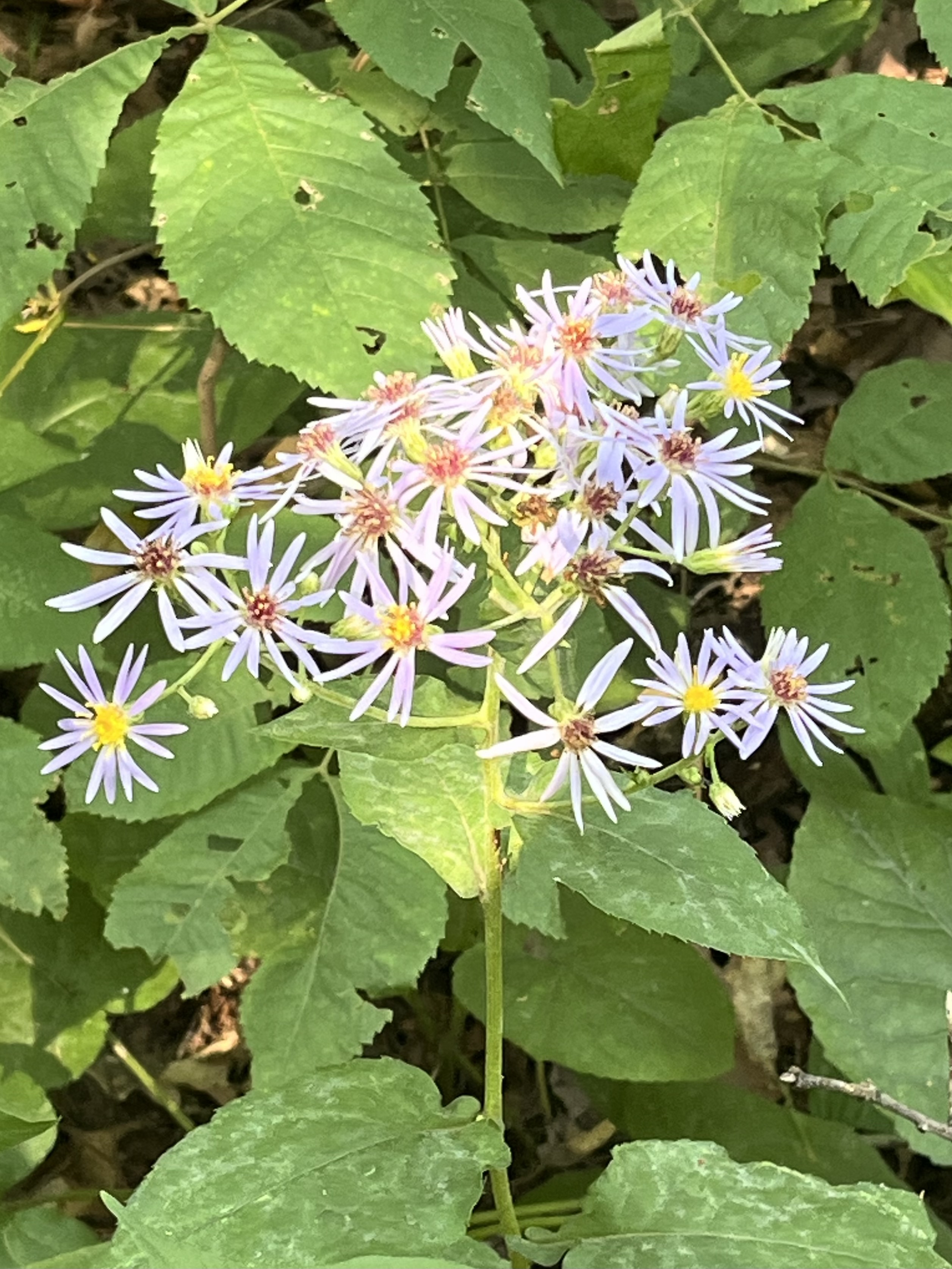
Large-leaved aster is a keystone plant, anchoring woodland ecosystems in late summer and early fall. Its broad basal leaves shelter invertebrates and retain moisture, while rhizomes stabilize soil and suppress invasives. Blooming late in the season, it offers vital nectar and pollen to native bees when few other wildflowers remain. As a host plant for the silvery checkerspot and pearl crescent butterflies, it nourishes caterpillars that in turn feed birds—adding to the importance of its role.

Botanically, the large-leaved aster is a native, perennial wildflower that grows two to three feet tall. Its flowers—white or violet—appear in open clusters, offering a soft contrast to the forest floor. The plant is named for its four to eight-inch heart-shaped basal leaves, which ground its presence, while smaller, stalkless, lance-shaped leaves alternate along the stem. It thrives in open woodlands and woodland openings, preferring dry to moist soils. Both ecologically and aesthetically, it’s a plant that invites quiet admiration and thoughtful inclusion in restoration and outreach.  (SF)  


Slender Mountain Mint (Pycnanthemum tenuifolium)


Slender Mountain Mint (Pycnanthemum tenuifolium) 

Slender mountain mint, native to eastern and central United States, offers exceptional ecological benefits, especially in prairie restorations and pollinator gardens. Its dense clusters of nectar-rich flowers support a wide diversity of native bees, butterflies, and beneficial flies, making it a keystone species for midsummer to fall forage. The plant’s upright, rhizomatous growth helps stabilize soil and resist erosion, while its aromatic foliage deters browsing by deer and rabbits—allowing it to persist in challenging sites. Adaptable to dry, rocky soils and full sun, it thrives where other species may falter,  helping establish biodiversity into roadsides, field edges, and restoration plots. 

Slender mountain mint typically grows to a height of 2 to 3 feet. Its small, white flowers, often dotted with purple spots, are about 1/4 inch long and bloom in dense, terminal clusters. The leaves are very narrow and almost needle-like, up to 3 inches long and about 1/4 inch wide. They are opposite, linear, and hairless, with a prominent central vein and smooth margins. This plant is quite adaptable and can be found in a variety of habitats, including dry, open rocky woods, dry prairies, fields, along roadsides, stream sides, and in open, wet thickets. It prefers full sun to part shade and can thrive in dry to medium soil conditions. (SF)


Evening Primrose (Oenothera biennis)


Common Evening Primrose (Oenothera biennis)

Ecologically, common evening primrose earns it keep by supporting a wide range of pollinators across the day-night spectrum. While its luminous yellow flowers open in the evening and attract nocturnal visitors like moths, they also remain accessible to daytime and twilight pollinators, including native bees such as Lasioglossum species. This biennial not only provides extended nectar availability from summer into fall, but also feeds and shelters dozens of herbivorous insects, contributing to food webs that support birds and predatory arthropods. Its deep taproot improves soil structure, and its genetic diversity influences local insect communities, making it a keystone species in early successional habitats and prairie restorations.

Common evening primrose is a native biennial and sometimes short-termed perennial under some conditions. It grows three to five feet tall, variously hairy stems and leaves. The 3/4 to two-inch, yellow flowers form in small clusters at the top of the stem and upper leaf axils. Its alternating leaves are four to 12 inches long, hairy and lance shaped. It thrives in full sun to partial shade and medium-moisture, well-drained soils. Found in fields, dunes, beaches, roadsides, and other disturbed habitats, it plays a key role in early successional ecosystems. (SF)


Stiff Goldenrod (Solidago rigida)


Stiff Goldenrod (Solidago rigida) 

Stiff goldenrod (Solidago rigida) is a native perennial found widely across Wisconsin’s prairies, dry fields, and open woodlands. Typically growing between three to five feet tall, it features bright yellow flowers arranged in dense, flat-topped clusters. Each individual flower measures about 3/8 inch in diameter, while the entire inflorescence spans two to five inches across. The plant’s leaves are stiff and rough-textured, with basal leaves reaching up to ten inches long and five inches wide. Along the stem, leaves are alternately arranged—lower leaves are oblong and up to eight inches long, while upper leaves are lance-shaped and stalkless.

Ecologically, stiff goldenrod plays a vital role in supporting pollinators during the late summer and fall, when many other nectar sources have faded. Its flowers attract a wide variety of insects, including native bees, butterflies, hoverflies, and soldier beetles. Some specialist pollinators even rely on goldenrod species exclusively. After blooming, the plant produces fluffy seeds that persist into winter, providing food for birds such as goldfinches and chickadees. Its upright stems also offer perching and shelter for small wildlife, adding structural diversity to prairie and savanna habitats.

Beyond its value to pollinators and birds, stiff goldenrod contributes to soil health and stability. Its deep, fibrous roots help prevent erosion and improve soil structure, especially in degraded or disturbed areas. The plant also supports insect life cycles, serving as a host for the larvae of moths and butterflies, and forming goldenrod galls that offer overwintering habitat for various species. Its adaptability to dry, sandy, and rocky soils makes it a resilient choice for restoration projects, biodiversity corridors, and even formal plantings where ecological function is a priority. (SF)