Showing posts sorted by relevance for query LS. Sort by date Show all posts

Seneca Snakeroot (Polygala senega)


Seneca Snakeroot (Polygala senega)

Seneca snakeroot is a perennial herb typically 10 to 18 inches tall. Its flowers form dense, spike‑like racemes at the stem tip, with each small bloom about 1/6 inch long and colored white to greenish‑white, ending in a distinctive fringed crest. The leaves are 1 to 3 inches long and 1/3 to 1 1/3 inch wide, linear to lance‑elliptic, widest at or just below the midpoint, and either smooth or minutely hairy.

This species grows in full to partial sun and favors dry to mesic, well‑drained soils—especially sandy, gravelly, or rocky substrates. In Wisconsin it is found in prairies, savannas, open woodlands, and dry, rocky stream margins or slopes. Its presence often signals intact, undisturbed native plant communities.

Sources:

USDA PLANTS Database — Polygala senega species profile

Minnesota Wildflowers — Polygala senega (Seneca Snakeroot)

Illinois Wildflowers — Seneca Snakeroot (Polygala senega)

Flora of North America — Polygala senega botanical description

Michigan Flora / University of Michigan — Polygala senega account

NatureServe Explorer — Polygala senega conservation status and distribution

UW–Madison Division of Extension — Dry prairie and savanna species of Wisconsin


(LS)

Smooth Sweet Cicely (Osmorhiza longistylis)


Smooth Sweet Cicely (Osmorhiza glabrata)

Smooth sweet cicely is a native perennial of Wisconsin’s rich woodlands, typically growing one to three feet tall. In late spring, it produces delicate clusters of tiny white flowers, each only about 1/16 to 1/8 inch wide, arranged in small, open umbels at the tips of stems and branches. Like other members of the carrot family, each flower has five white petals, five stamens, and two slender styles that extend slightly beyond the petals.

Its foliage is one of its most distinctive features. The leaves are compound, fern‑like, and finely divided, usually three to six inches long. Each leaf is split into three main sections, and each section is further subdivided into smaller leaflets, giving the plant a soft, lacy appearance on the forest floor.

Smooth sweet cicely grows in moist, well‑drained soils of shaded to partially shaded woods, ravines, and slopes. It favors the humus‑rich, slightly acidic to neutral soils typical of mature forests. The plant is an important nectar source for a wide range of small pollinators, including bees, flies, wasps, and moths, all of which are drawn to the accessible flowers of umbellifers.

Reproduction occurs primarily through seed, which ripens in elongated, aromatic fruits typical of the genus. Seeds require a period of cold stratification to germinate, often sprouting the following spring. Unlike garden perennials, smooth sweet cicely is not typically propagated by division or cuttings; its roots are delicate, and the plant prefers to establish naturally from seed within stable woodland soils.

A long‑lived species, smooth sweet cicely persists quietly in the understory, contributing to the structure and diversity of Wisconsin’s forest communities. When brushed or crushed, its foliage releases a subtle anise‑like fragrance, a reminder of its place among the aromatic members of the carrot family.

UW–Madison Herbarium — Osmorhiza glabrata species account

Illinois Wildflowers — Smooth Sweet Cicely (Osmorhiza glabrata)

Missouri Botanical Garden — Osmorhiza glabrata profile

USDA NRCS Plants Database — Osmorhiza glabrata species information

Lady Bird Johnson Wildflower Center — Osmorhiza glabrata plant profile

 (LS)  


Wild Geranium (Geranium maculatum)


Wild Geranium (Geranium maculatum)

Wild geranium opens its five‑petaled flowers at the tips of leafy stems that stand one to three feet tall, but what draws pollinators in isn’t just the color—it’s the timing. By the time these lavender blossoms appear in May, many early‑spring ephemerals have already faded, and bumble bees, miner bees, and syrphid flies are eager for new pollen sources. Wild geranium obliges with generous pollen (but no nectar), and those visits help fuel the next wave of woodland insects. Its deeply cut, five‑ to seven‑lobed leaves catch the shifting light along woodland edges, while the basal leaves—four to five inches long, coarsely veined, and sharply toothed—anchor the plant in the cool soils of dry or moist woodlands, shaded meadows, and partial‑shade forest openings. Loose clusters of two to five flowers form at the ends of branching stems, each bloom one to one‑and‑a‑half inches across, lifting just high enough to meet the foraging paths of early‑season pollinators.

Sources:

USDA Forest Service – Geranium maculatum (Wild Geranium)

Minnesota Wildflowers – Wild Geranium (Geranium maculatum)

Illinois Wildflowers – Wild Geranium

Lady Bird Johnson Wildflower Center – Geranium maculatum

Wisconsin DNR – Wisconsin Native Plants: Wild Geranium

Missouri Botanical Garden – Geranium maculatum: Ecology and Identification

(LS)   

Wild Calla (Calla palustris)


Top photo by Carla Wells

Wild Calla (Calla palustris) 

Many people in Wisconsin think Wild Calla is rare, but it only seems that way because it keeps to the bog mats, the quaking peat, the shaded pools where most of us don’t wander. In the places it chooses, though, it’s anything but scarce. It’s a structural species in northern wetlands, doing the slow, essential work of holding those fragile systems together.

Its ecological value shows up first in the way it roots itself. Wild Calla spreads by creeping rhizomes that weave through sphagnum and saturated peat, helping anchor the floating edges of bogs and swamps. That hidden lattice strengthens the mats that shelter salamanders, cradle sedges and mosses, and maintain the cool, acidic conditions that define northern bog communities. Even a modest colony can lend stability to a wetland that depends on interlocking vegetation to stay intact.

Wild Calla blooms once the wetland has warmed, and its pale spadix draws in small flies—especially fungus gnats—that handle most of its pollination. Flowering in late spring places it among the other plants active at that time, adding another dependable source of pollen and structure for insects that specialize in cool, saturated habitats.

The plant itself is striking once you know where to look. It rises six to sixteen inches above the waterline, sending up a stout stem topped with a single cylindrical spike wrapped in a smooth, waxy, creamy‑white spathe. That spathe, broadly oval to elliptic and one to three inches long, stands out against the dark greens of the wetland. Below it, glossy, leathery, heart‑shaped leaves with rounded basal lobes float or arch above the water, giving the plant a sculptural presence.

Wild Calla grows in part shade or sun in bogs, swamps, wet ditches, and shallow water—habitats that hide it from casual view but reveal its abundance to anyone willing to step into the muck and moss. It’s not a rarity so much as a specialist, thriving in Wisconsin’s wildest wetlands.

Sources: 

Flora of North America – Calla palustris

Minnesota Wildflowers – Calla palustris (Wild Calla)

USDA Plants Database – Calla palustris

Illinois Wildflowers – Wild Calla (Calla palustris)

Michigan Flora – Calla palustris (distribution and habitat)

New England Wild Flower Society / Go Botany – Calla palustris

 
(LS)


Canada Mayflower (Maianthemum canadense)


Canada Mayflower (Maianthemum canadense)

Canada mayflower (Maianthemum canadense) is a delicate, native perennial wildflower found throughout Wisconsin and much of the northeastern United States. This small woodland plant grows three to six inches tall and thrives in cool, shaded forests, especially in moist, mossy areas beneath conifers or mixed hardwoods. Its preference for shade to part shade makes it a characteristic species of rich northern woods.

In spring, Canada mayflower produces a short, upright cluster of tiny, star‑shaped white flowers. Each bloom has four tepals and four stamens, giving the cluster a fine, airy appearance. The plant typically bears one or two leaves, occasionally three, which are oval to heart‑shaped, smooth‑edged, and one to three inches long. These leaves arise near the base of the stem rather than alternating along it.

Canada mayflower spreads vigorously by underground rhizomes, forming dense carpets that help stabilize forest soils and suppress erosion. By midsummer, the flowers give way to small berries that ripen from green to mottled red with pale speckles. These fruits are eaten by a variety of wildlife, including birds, chipmunks, mice, and ruffed grouse.

In garden settings, Canada mayflower is a valuable native groundcover for shaded areas. It adapts well to acidic, humus‑rich soils and can tolerate both moist and moderately dry conditions once established. Its ability to form lush, low‑growing colonies makes it an appealing choice for naturalistic plantings and for gardeners seeking to enhance biodiversity with dependable woodland species.

Sources:

UW–Madison Herbarium — Maianthemum canadense species account

USDA NRCS Plants Database — Maianthemum canadense species information

Lady Bird Johnson Wildflower Center — Maianthemum canadense plant profile

Flora of North America — Maianthemum canadense treatment

Minnesota Wildflowers — Canada Mayflower (Maianthemum canadense)

(LS)

Gaywings (Polygaloides paucifolia)


Gaywings (Polygaloides paucifolia)

Photo by Judith Kozminski

Gaywings, also known as fringed polygala, is a small, spring‑blooming wildflower native to Wisconsin and much of the northeastern United States. This perennial grows in acidic, humus‑rich conifer or mixed forests, often beneath pines or hemlocks, where it thrives in part shade to full shade. Plants typically reach three to seven inches tall, forming low patches on the forest floor.

Each plant produces one to four blossoms, deep pink to nearly white, each less than an inch wide. The flowers are unmistakable: two large, wing‑like sepals flare outward like tiny propellers, while the lower petal forms a fringed keel that gives the species its common name. The leaves cluster toward the tip of the stem, elliptic, smooth‑edged, and sometimes fringed with minute hairs.

Blooming in spring to early summer, gaywings add a vivid splash of color to shaded woodlands. Their ecological role extends beyond pollination by small bees. Like many spring wildflowers, they rely on ants for seed dispersal, a strategy known as myrmecochory. The seeds bear elaiosomes, nutrient‑rich attachments that attract ants. Ants carry the seeds back to their nests, consume the elaiosomes, and leave the seeds to germinate underground. This process helps spread the plant across the forest floor and supports genetic diversity within populations.

Sources:

UW–Madison Herbarium — Polygaloides paucifolia species account

USDA NRCS Plants Database — Polygaloides paucifolia species information

Lady Bird Johnson Wildflower Center — Polygala paucifolia plant profile

Flora of North America — Polygala paucifolia treatment

Minnesota Wildflowers — Gaywings (Polygala paucifolia)

(LS)

American Fly Honeysuckle (Lonicera canadensis)


American Fly Honeysuckle (Lonicera canadensis)

Not all honeysuckle plants are invasive. American fly honeysuckle is native to Wisconsin. It is a flowering, deciduous shrub that typically reaches a height of 24 to 72 inches. Its light yellow, tubular flowers bloom in late spring, appearing in pairs and measuring about ½ to ¾ inch long. The leaves are simple, light green, and range from 1½ to 3½ inches in length, growing in opposite pairs along the branches. The shrub’s stems are loosely branched, with light brown to brownish-gray bark, while its twigs can vary from green to purplish. This honeysuckle thrives in moist, well-drained soils but can tolerate rocky or gravelly conditions. It is fundamentally a cool forest shrub. It is commonly found in shady woodlands, stream banks, forest edges, and rich understory areas. 

Sources:

USDA PLANTS Database — Lonicera canadensis species profile

Minnesota Wildflowers — Lonicera canadensis (American Fly Honeysuckle)

Illinois Wildflowers — American Fly Honeysuckle (Lonicera canadensis)

Flora of North America — Lonicera canadensis botanical description

Michigan Flora / University of Michigan — Lonicera canadensis account

NatureServe Explorer — Lonicera canadensis conservation status and distribution

UW–Madison Division of Extension — Native woodland shrubs of Wisconsin

(LS)
 

Cream Wild Indigo (Baptisia bracteata)


Cream Wild Indigo (Baptisia bracteata)

On a May morning in the Driftless, when the prairie is still in transition from winter, cream wild Indigo is already awake—sprawling its pale, heavy, creamy yellow colored flower clusters outward. Cream wild indigo is a perennial legume native to Wisconsin and much of the central and eastern United States. It grows 12 to 24 inches tall and can spread up to three feet wide, forming a broad, low mound of round, light green stems. Its alternate leaves are divided into three smooth‑edged leaflets, typically one to three inches long, most often oblanceolate—broadest near the tip rather than the base.

The plant’s signature feature is its long, drooping racemes, which sprawl sideways rather than standing upright. Each raceme holds numerous creamy yellow to whitish pea‑type flowers, blooming April through June depending on latitude—placing Wisconsin’s bloom window solidly in May to early June. These early blossoms are pollinated primarily by queen bumblebees, which emerge in spring searching for nest sites and rely on early nectar sources. After flowering, cream wild indigo forms oval to cylindrical seed pods about 1–2 inches long that mature to blue‑black or nearly black by fall.

Ecologically, this species is a workhorse. As a legume, it participates in nitrogen fixation, enriching the surrounding soil community. It is also a host plant for several skipper butterflies, including the wild indigo duskywing and hoary edge. The orange sulphur occasionally uses baptisia species, but this is less consistently documented; the two skipper species reliably use cream wild indigo as their host plant.

Despite its soft, velvety look, cream wild indigo is tough and drought‑tolerant once established. It thrives in full sun to part shade and well‑drained to rocky soils, typical of prairies, savannas, and open woodlands. Its deep taproot makes it long‑lived but difficult to transplant—best planted where it can remain undisturbed.

Sources:

Minnesota Wildflowers — Baptisia bracteata (Plains Wild Indigo)

Illinois Wildflowers — Cream Wild Indigo (Baptisia bracteata)

Lady Bird Johnson Wildflower Center — Baptisia bracteata

Grow Native! — Cream Wild Indigo

Go Botany — Baptisia bracteata (Long‑bracted Wild Indigo)

(LS)
 

White Wild Indigo (Baptisia alba)


White Wild Indigo  (Baptisia alba)

Rising three to four feet above the prairie, white wild indigo flower spikes stand like small beacons in early summer, bright against the greens and golds of Wisconsin’s open landscapes. A native perennial found throughout the central and eastern United States, Baptisia alba is a tough, long‑lived plant built for the extremes of Midwestern weather.

Its tall, erect stems hold long racemes of pea‑shaped blossoms, each about an inch long and reminiscent of lupine. When the flowers open, they draw in bees, butterflies, and other pollinators, adding motion and sound to prairies, open woodlands, and roadsides.

The foliage is just as distinctive. Bluish‑green compound leaves, divided into three leaflets two to four inches long, give the plant a clean, architectural look. This trifoliate structure, paired with a deep, resilient root system, helps the plant withstand drought, poor soils, and the pressures of full sun. Once established, white wild indigo shrugs off deer, disease, and long dry spells, making it a reliable choice for restorations, erosion control, and tough roadside plantings.

As a legume, it fixes nitrogen and enriches the soil around it. Its flowers feed a wide range of pollinators, and its foliage supports the larvae of the wild indigo duskywing butterfly. In a healthy prairie, Baptisia alba is both a visual anchor and a driving force for biodiversity.

Sources:

Illinois WildflowersWhite Wild Indigo
Lady Bird Johnson Wildflower CenterBaptisia alba Profile
USDA Plants DatabaseBaptisia alba
PRAIRIE MOON NURSERYWhite Wild Indigo
PRAIRIE NURSERYWhite Wild Indigo
Wisconsin DNRNative Plant Information: Baptisia

(LS)

Bunchberry Dogwood (Cornus canadensis)


Bunchberry Dogwood (Cornus canadensis) 

Photo by Jan Tezlaff

Bunchberry dogwood (Cornus canadensis) is a low‑growing perennial native to northern North America, including Wisconsin, as well as much of Canada and parts of the northeastern United States. This plant thrives in cool, damp, and shady woodlands, often found beneath towering trees and shrubs.

Typically reaching just six to nine inches in height, bunchberry dogwood forms a dense, ground‑covering mat that plays an important role in forest function. Its creeping rhizomes help stabilize the thin, organic soil layer on the forest floor, slowing erosion and holding moisture where seedlings, mosses, and fungi depend on it. The plant’s low canopy shades the soil, reducing evaporation and maintaining the cool microclimate characteristic of northern hardwood and conifer forests. In late spring, its tiny true flowers—surrounded by four white bracts—provide nectar and pollen for small native bees and flies. By late summer, the bright red berries offer food for thrushes, grouse, chipmunks, and other wildlife, adding diversity to the seasonal diet of forest animals.

A key characteristic of bunchberry dogwood is its veining—unlike many plants, its veins curve outward toward the leaf tip. The short‑stalked leaves measure around three inches long and two inches wide, with a distinct wedge‑shaped base and abruptly pointed tips.

Sources:

USDA Plants Database — Cornus canadensis profile

Minnesota Wildflowers — Bunchberry

Go Botany (Native Plant Trust) — Cornus canadensis

Fire Effects Information System (USFS) — Cornus canadensis

Flora of North America — Cornus canadensis

(LS)

Solomon's Plume (Maianthemum racemosum)


Solomon's Plume (Maianthemum racemosum)

Solomon’s plume feeds wildlife and shelters them under its ground cover. Its berries—ripening from green to speckled red—are eaten by thrushes, catbirds, grouse, and small mammals, helping disperse the plant through forest soils. As a rhizomatous perennial, it also forms broad colonies that stabilize leaf litter and enrich the woodland floor.

A native wildflower, Solomon’s plume grows one to three feet tall on a single arching stem tipped with a three‑ to five‑inch cluster of tiny, star‑shaped, creamy white flowers. Its alternate, stalkless leaves are oval and three to six inches long, each marked by conspicuously parallel veins that give the plant its distinctive texture. Over time, its spreading rhizomes allow it to form large, graceful drifts in shaded, deciduous forests, where it thrives in rich, moist soils.

Sources:

Minnesota Wildflowers — Maianthemum racemosum (Solomon’s Plume)

Illinois Wildflowers — False Solomon’s Seal

Lady Bird Johnson Wildflower Center — Maianthemum racemosum

Missouri Botanical Garden — Maianthemum racemosum

USDA NRCS — Maianthemum racemosum Plant Profile

(LS)

Veiny Pea (Lathyrus venosus)


Veiny Pea (Lathyrus venosus)

The Veiny Pea is a native, perennial wildflower. It can grow to 40 inches tall. It has pea-shaped flowers that are bi-colored, with a richly lavender and pink upper lip and pale pink lower petals. The flowers have distinct veins on the upper lip. The leaves are compound with four to seven leaflet pairs. The leaves are oval to oblong-elliptic, rounded at both ends, and can be finely hairy or nearly smooth. It grows in dry open woodlands, thickets, and moist to wet soils. 

As a native legume, it enriches the soil by fixing atmospheric nitrogen, feeding the microbial communities that support surrounding grasses, sedges, and wildflowers. Its blossoms provide nectar and pollen for early‑season bumble bees, leafcutter bees, and small native solitary bees that rely on pea‑family plants for both food and nesting materials. The plant’s sprawling stems offer shelter for ground‑dwelling insects and small amphibians, while its seeds feed birds and small mammals later in the season. In dry woodlands, thickets, and moist edges alike, veiny pea helps knit the plant community together—stabilizing soil, supporting pollinators, and adding resilience to the shifting boundary between forest and field.

Sources:

USDA Plants Database – Lathyrus venosus Species Profile

Lady Bird Johnson Wildflower Center – Native Plant Database: Veiny Pea (Lathyrus venosus)

Minnesota Wildflowers – Veiny Pea Identification and Habitat

Illinois Wildflowers – Veiny Pea Ecology and Pollinator Associations

Wisconsin DNR – Native Legumes and Their Role in Soil Enrichment

US Forest Service – Nitrogen‑Fixing Native Plants and Woodland Ecology

Sauk Prairie Conservation Alliance – Woodland and Thicket Plant Communities of Southern Wisconsin


(LS)

Annual Fleabane (Erigeron annus)


 Annual Fleabane (Erigeron annus) 

Annual fleabane (Erigeron annuus) is a native Wisconsin wildflower common in disturbed places such as pastures, old fields, roadsides, and railways. It typically grows one to three feet tall, occasionally taller in rich soils. By late spring it produces loose clusters of small aster-like flower heads: a bright yellow center of tubular disk florets surrounded by 50 to 100 narrow rays that range from white to pale lavender. Each flower head measures about one-half to three-quarters of an inch across, creating the plant’s soft, airy appearance.

The leaves are alternate and sessile, attaching directly to the stem. Lower leaves are broader and often toothed, while the upper leaves become narrower and mostly untoothed. The stems are green and sparsely hairy, giving the plant a slightly rough texture.

As a pioneer species, annual fleabane readily colonizes disturbed soils, helping to stabilize loose ground and provide early nectar and pollen for small bees, syrphid flies, and tiny wasps. It plays a useful early role in restoration sites, though it is not a strong competitor against aggressive invasive plants.

Sources:

UW–Madison Herbarium — Erigeron annuus

Flora of North America — Erigeron annuus

Illinois Wildflowers — Annual Fleabane (Erigeron annuus)

Missouri Botanical Garden — Erigeron annuus

USDA Plants Database — Erigeron annuus

(LS) 


Slender Yellow Wood Sorrel (Oxalis dellenii)


Slender Yellow Wood Sorrel (Oxalis dellenii)

Wood Sorrel is a native, perennial wildflower in Wisconsin that brings a splash of vibrant yellow to prairies, plains, meadows, pastures, savannas, and woodland edges. Growing between six and fifteen inches tall, its delicate half-inch-wide flowers, each with five petals, brighten the landscape. The plant's clover-like leaves make it easy to identify, and they contribute to its reputation among gardeners. While some gardeners appreciate Wood Sorrel for its resilience and ability to thrive in dry soils under full sun, others see it as a persistent guest in their gardens. Its rapid growth and tendency to spread can make it feel more like an enthusiastic wanderer than a planned addition. 

Sources:

USDA Plants Database – Oxalis dillenii Species Profile

Lady Bird Johnson Wildflower Center – Native Plant Database: Slender Yellow Wood Sorrel

Minnesota Wildflowers – Slender Yellow Wood Sorrel Identification and Habitat

Illinois Wildflowers – Yellow Wood Sorrel Ecology and Growth Habit

Wisconsin DNR – Native Prairie and Savanna Wildflowers of Southern Wisconsin

Iowa State University Extension – Oxalis Species and Their Ecological Roles

Sauk Prairie Conservation Alliance – Prairie Edge Plant Communities and Early‑Season Wildflowers


(LS)

Red Columbine (Aquilegia canadensis)


Red Columbine (Aquilegia canadensis)

Red columbine rises only about two feet from the forest floor, but its flowers—drooping, red and yellow, with upward‑curving spurs and spreading sepals—carry a large presence. Even in shade, the blossoms seem to glow. When the light hits just right, the numerous yellow stamens hanging below the petals seem to shimmer. This wildflower favors the quiet places: part shade, sandy and well‑drained soils, the edges of deciduous woods where spring light still reaches the ground. I often find it growing along a trail cut through oak and maple, or in the thin, shifting boundary between woodland and prairie.

It is also important ecologically. It is a keystone early‑season resource, offering nectar precisely when migrating and newly arrived hummingbirds need it most. The flower’s long, upward spurs are perfectly shaped for the beaks of ruby‑throated hummingbirds, which become its primary pollinators. Bumble bees and hawk moths visit too, each taking advantage of the rich nectar tucked deep within the flower. The plant’s foliage shelters small insects, while its seeds feed ground‑foraging birds and small mammals later in the season. As a native perennial, it also helps stabilize loose woodland soils, weaving its roots through sandy pockets where erosion might otherwise take hold.

Sources:

USDA Plants Database – Aquilegia canadensis Species Profile

Lady Bird Johnson Wildflower Center – Native Plant Database: Red Columbine

Minnesota Wildflowers – Red Columbine Identification and Habitat

Illinois Wildflowers – Red Columbine Ecology and Pollinator Relationships

Wisconsin DNR – Native Woodland Wildflowers of Southern Wisconsin

Cornell Lab of Ornithology – Ruby‑throated Hummingbird Feeding Behavior and Plant Associations

Sauk Prairie Conservation Alliance – Woodland Edge Plant Communities and Early‑Season Bloomers

(LS)

Star Flower (Trientalis borealis)


Star Flower (Trientalis borealis)

Starflower's white, seven‑pointed blooms hover just above the leaf litter, small but unmistakably bright against the dim understory. A native perennial across Wisconsin and the northern forests of the United States, Trientalis borealis thrives where the soil runs acidic and the light filters softly through conifers and hardwoods.

Growing four to eight inches tall, starflower is modest in stature but elegant in form. One or two star‑shaped blossoms rise on slender stalks above a whorl of five to seven lance‑shaped leaves. Each flower is about half an inch wide, its sharply pointed petals giving it the symmetry that makes the plant so distinctive.

Starflower’s blooms offer nectar to native bees and other small pollinators that work the forest floor in spring and early summer. The plant spreads by thin, creeping rhizomes, forming loose colonies that help it persist in the shifting conditions of moist to dry, acidic woodland soils. Where it grows well, starflower contributes to the layered structure of healthy northern forests — one of the many small species that, together, sustain the diversity and resilience of these ecosystems.

Sources:

USDA Forest Service — Starflower (Trientalis borealis
Minnesota Wildflowers — Lysimachia borealis (Starflower) 
Illinois Wildflowers — Starflower (Lysimachia borealis) 
Lady Bird Johnson Wildflower Center — Lysimachia borealis Profile
Flora of North America — Lysimachia borealis 
Wisconsin State Herbarium — Lysimachia borealis (Starflower)

(LS)


Ohio Spiderwort (Tradescantia ohiensis)


Ohio Spiderwort (Tradescantia ohiensis)

Ohio spiderwort earns its ecological value by supporting pollinators during a seasonal lull, when spring ephemerals are fading and summer prairie flowers haven’t yet taken over. In Wisconsin, it begins blooming in late May, offering nectar and pollen just as bumblebees, sweat bees, and other early‑summer pollinators are ramping up. Because the plant produces new buds continuously, fresh flowers across several weeks, creating a steady, reliable resource during this transition period.

A native perennial, Ohio spiderwort grows one to three feet tall on upright, unbranched stems. Its three‑petaled flowers range from blue to violet, with occasional pink or nearly white forms, and each bloom carries six hairy, yellow‑tipped stamens that give the flower its distinctive texture. The blossoms appear in terminal clusters of up to 20, each cluster subtended by long, slender, leaf‑like bracts.

The plant’s grass‑like leaves form a basal clump, each leaf 8–16 inches long and typically less than an inch wide, arching as the season progresses. Ohio spiderwort grows best in sunny, moist, well‑drained soils, but it is notably adaptable, tolerating partial shade, drier conditions, and a range of soil types once established.

Sources:

Minnesota Wildflowers — Ohio Spiderwort (Tradescantia ohiensis)

Illinois Wildflowers — Ohio Spiderwort

Lady Bird Johnson Wildflower Center — Tradescantia ohiensis

Missouri Botanical Garden — Tradescantia ohiensis

Wisconsin DNR — Spiderworts of Wisconsin

(LS)

Spreading Dogbane (Apocynum androsaemifolium)


Spreading Dogbane 

Spreading dogbane’s early‑summer nectar is a steady resource for native bees, wasps, and small butterflies, and the plant’s dense, milky sap makes it an important host for several specialist insects that have adapted to its chemistry. In dry, open habitats—roadsides, sandy clearings, and woodland edges—it helps anchor thin soils, and its leafy structure offers shelter for ground‑nesting pollinators moving between patches of bloom.

A native perennial, spreading dogbane grows one to four feet tall, with simple, oval, toothless leaves two to four inches long, often edged with a slight wave. The flowers appear in loose groups of two to ten. Each is only about a quarter inch wide—white, bell‑shaped, and striped with pink, the five petals fused into a delicate cup. You’ll find the plant in dry, sunny places along roads and the margins of deciduous woods. 

Sources: 

USDA NRCS — Apocynum androsaemifolium Plant Guide

Minnesota Wildflowers — Spreading Dogbane (Apocynum androsaemifolium)

Illinois Wildflowers — Spreading Dogbane

Lady Bird Johnson Wildflower Center — Apocynum androsaemifolium Species Profile

Michigan State University Extension — Dogbane Identification and Ecology

 (LS)


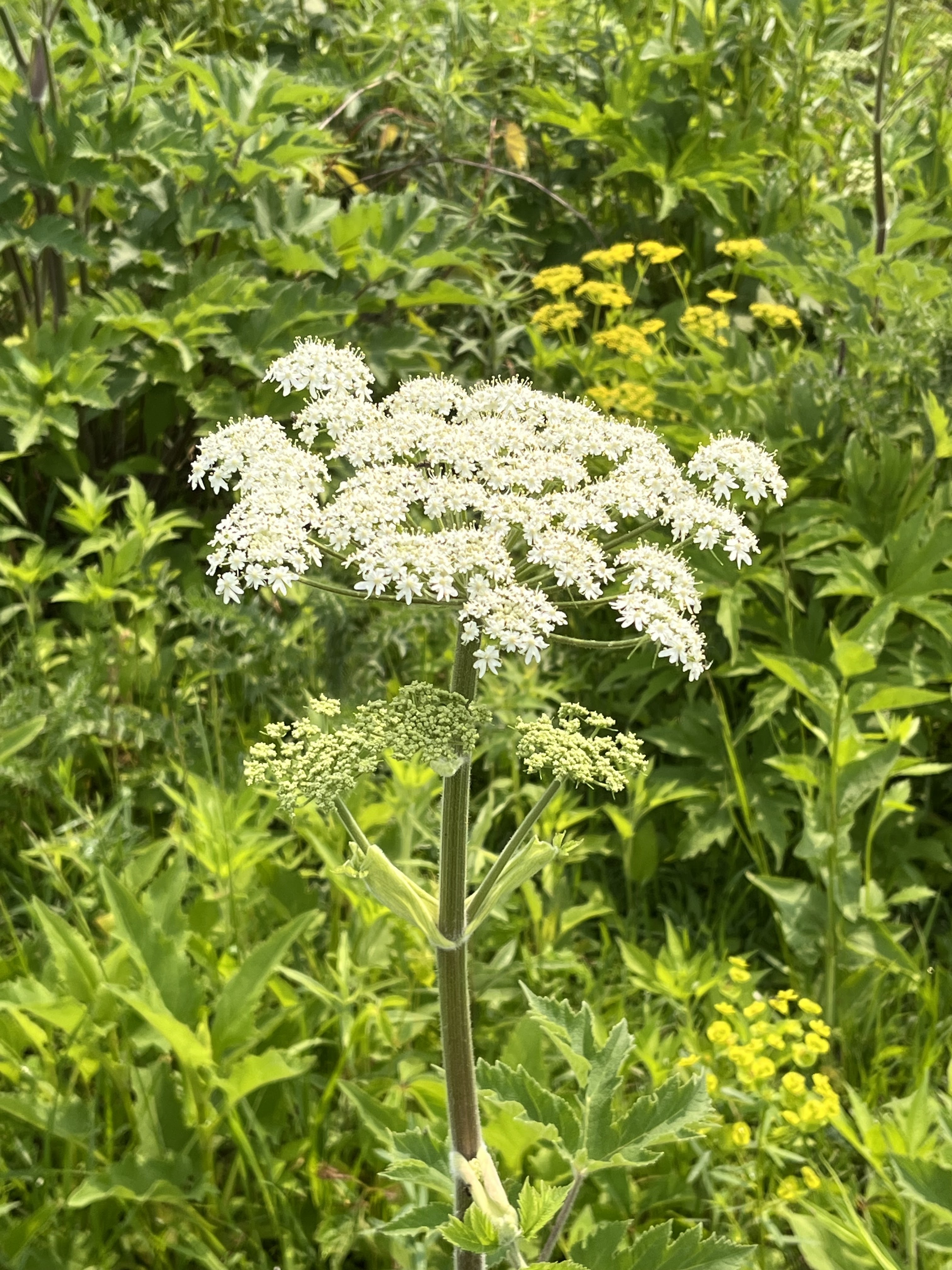
Cow Parsnip (Heracleum maximum)


Cow Parsnip (Heracleum maximum)

Cow parsnip (Heracleum maximum) is a tall, native wildflower found across North America, including Wisconsin. It typically grows 4 to 10 feet tall and bears broad, flat‑topped compound umbels of small white flowers, each umbel spanning 4 to 12 inches across. Individual flowers are about a quarter inch wide, with larger, showier blossoms often forming a lacy ring around the edge. The leaves are enormous and divided into three large lobes or leaflets, with basal leaves reaching up to 18 inches long and wide; their surfaces are softly hairy and coarsely toothed. The stem is thick, hollow, ridged, and covered in fine white hairs, sometimes approaching 2 inches in diameter. Cow parsnip thrives in full sun to partial shade in moist, nutrient‑rich soils, especially along streambanks, forest edges, wet meadows, and cool alluvial flats. Its sap contains furanocoumarins that can cause skin irritation when exposed to sunlight, making it a plant best admired without handling. Ecologically, cow parsnip is an important summer nectar source, supporting a wide range of pollinators—including bees, flies, beetles, and butterflies—drawn to its abundant, accessible umbels.

Sources:

USDA PLANTS Database — Heracleum maximum species profile

Minnesota Wildflowers — Heracleum maximum (Cow Parsnip)

Illinois Wildflowers — Cow Parsnip (Heracleum maximum)

Flora of North America — Heracleum maximum botanical description

Michigan Flora / University of Michigan — Heracleum maximum account

NatureServe Explorer — Heracleum maximum conservation status and distribution

UW–Madison Division of Extension — Native wetland and riparian plants of Wisconsin

(LS)


Canada Violet (Viola canadensis)


Canada Violet (Viola canadensis)

In the cool understory of Wisconsin’s deciduous woods, Canada Violet offers early nectar to queen bumble bees just emerging from their winter shelters. Its flowers also support small solitary bees and early hoverflies—pollinators that depend on spring woodland blooms before the canopy closes. The plant’s broad, heart‑shaped leaves help stabilize moist forest soils, and its presence often signals a healthy, undisturbed woodland floor with rich organic matter. Where Canada violets grow well, other spring ephemerals usually thrive too, forming the layered groundcover that keeps these forests functioning.

The Canada violet itself is a native, perennial wildflower in Wisconsin, growing eight to 16 inches tall. Its white, violet‑shaped flowers are about an inch wide, each with a yellow center and a slender purplish stalk that lifts the bloom just above the leaves. The leaves are heart‑shaped, one to three inches wide, and notably lack teeth. You’ll find this species in moist, cool, rich deciduous woods—places where spring sunlight filters through bare branches and the soil stays damp enough for its shallow roots.

Sources

• Wisconsin State Herbarium
• USDA Plants Database
• Illinois Wildflowers
• Flora of Wisconsin (UW–Madison)
• Minnesota Wildflowers

 (LS)