Seneca Snakeroot (Polygala senega)
Smooth Sweet Cicely (Osmorhiza longistylis)
Smooth Sweet Cicely
Smooth sweet cicely (Osmorhiza glabrata) is a native, perennial wildflower in Wisconsin, typically reaching heights of one to three feet. It produces small, white flowers about 1/8 inch wide, which are arranged in flat clusters (umbels) at the top of the plant and along branching stems. Each flower consists of five white petals, five white-tipped stamens, and two elongated white styles that exceed the length of the petals. The leaves are lush, fern-like, and compound, measuring three to six inches in length. They are divided into three parts, with each section further subdivided into smaller segments, creating an intricate and delicate appearance. This plant thrives in rich woods and wooded slopes, preferring moist, well-drained soil with shade to partial shade, and it serves as an important food source for pollinators such as bees, flies, wasps, and moths.
Smooth sweet cicely favors soil that is neutral to slightly alkaline, though it can tolerate a pH range of 6.0 to 7.0. Consistent moisture is crucial for its health, but excessive wetness should be avoided. It propagates mainly through seeds, which take anywhere from 14 to 30 days to germinate depending on soil conditions. Division of established plants is another effective propagation method, typically performed in early spring or fall. While stem cuttings are sometimes used for propagation, they are far less reliable than seeds or division. When planting, seeds should be placed one to two inches deep and spaced 12 to 18 inches apart to allow for proper growth and airflow. The plant has a lifespan of three to five years, making it a dependable addition to gardens where its delicate, anise-like fragrance and medicinal qualities can be appreciated. Light fertilization in early spring promotes healthy development, and its adaptability to shaded landscapes makes it a valuable choice for naturalistic plantings and pollinator support. (LS)
Wild Geranium (Geranium maculatum)
Wild Calla (Calla palustris)
Canada Mayflower (Maianthemum canadense)
The flowers of Canada mayflower are tiny and star-shaped.Typically, each bloom consists of two petals and two sepals, which are often white or cream-colored. Their arrangement gives the appearance of a tiny bell. The leaves are simple and alternate along the stem, oval or elliptical in shape, and range from two to four inches in length. Each node on the stem produces a single leaf, creating a distinctive pattern.
Beyond this, Canada mayflower plays an important ecological role. It spreads through underground rhizomes, forming dense colonies that help stabilize forest soils and prevent erosion. The plant also provides food for various wildlife species. Its berries, which transition from green to a dull red with white speckles, are consumed by birds and small mammals, including ruffed grouse, mice, and chipmunks.
Canada mayflower is also valuable in garden settings, particularly for those looking to cultivate native plants. It serves as an excellent groundcover for shaded areas, adapting well to a variety of soil types. Because it spreads by rhizomes, it can create a lush, low-growing carpet in woodland gardens. Its ability to thrive in both moist and dry conditions makes it a versatile choice for gardeners seeking to enhance biodiversity while maintaining a natural aesthetic. (LS)
Gaywings (Polygaloides paucifolia)
Gaywings, also known as Fringed Polygala,(Polygaloides paucifolia) is a wildflower native to Wisconsin and much of the northeastern United States. It is a perennial plant that thrives in dry to moist conifer forests, often under pines, and prefers part shade to shade. It is a small plant, reaching only three to seven inches in height. Each plant produces one to four deep pink to nearly white blossoms, each less than an inch wide. The flowers have two oval sepals that resemble petals and flare out like wings, giving them their distinctive appearance. The leaves are crowded toward the tip of the stem, elliptic in shape, with toothless edges that are often fringed with short hairs. Their bloom time is typically in the spring to early summer, adding a splash of color to the forest floor.
In addition to attracting pollinators with their nectar, gaywings play another important ecological role. Like many spring wildflowers, they rely on ants for seed dispersal, a strategy known as myrmecochory. Their seeds have nutrient-rich attachments called elaiosomes that attract ants, which then carry the seeds into their nests. The ants consume the elaiosomes, leaving the seeds to germinate underground, far from the parent plant. This process helps maintain genetic diversity and ensures the continued spread of the species.
They can also be successfully grown in shade gardens. They thrive in acidic, well-drained, organic soils and do best when planted without competition from aggressive species. Their slow-growing, semi-evergreen nature makes them an excellent groundcover for woodland gardens. (LS)
American Fly Honeysuckle (Lonicera canadensis)
Cream Wild Indigo (Baptisia bracteata)
White Wild Indigo (Baptisia alba)
The foliage of white wild indigo is equally distinctive. Its bluish-green compound leaves are divided into three leaflets, each ranging from two to four inches in length. This unique leaf structure contributes to the plant’s ability to withstand drought and poor soil conditions, making it a resilient addition to natural landscapes.
Additionally, white wild indigo plays an essential ecological role. As a member of the legume family, it helps improve soil health by fixing nitrogen, enriching the surrounding environment for other plants. It is also a valuable nectar source for bees, butterflies, and other pollinators, supporting biodiversity in prairie ecosystems. Plus, the plant serves as a host for the larvae of the wild indigo duskywing butterfly.
In garden settings, white wild indigo is a fantastic choice for those looking to cultivate native plants. It thrives in full sun to partial shade and adapts well to a variety of soil types, including clay and sandy soils. Once established, it requires minimal maintenance, as it is highly resistant to drought, deer, and disease. Its deep root system makes it an excellent choice for erosion control, particularly in prairie restorations and roadside plantings. (LS)
Bunchberry Dogwood (Cornus canadensis)
Solomon's Plume (Maianthemum racemosum)
Veiny Pea (Lathyrus venosus)
The Veiny Pea is a native, perennial wildflower. It can grow to 40 inches tall. It has pea-shaped flowers that are bi-colored, with a richly lavender and pink upper lip and pale pink lower petals. The flowers have distinct veins on the upper lip. The leaves are compound with four to seven leaflet pairs. The leaves are oval to oblong-elliptic, rounded at both ends, and can be finely hairy or nearly smooth. It grows in dry open woodlands, thickets, and moist to wet soils. (LS)
Annual Fleabane (Erigeron annus)
Annual Fleabane, scientifically known as Erigeron annuus, is a native wildflower in Wisconsin that thrives in disturbed areas such as pastures, abandoned fields, roadsides, and railways. This adaptable plant grows between one and five feet tall, producing delicate aster-like flowers in the spring. Each flower features a bright yellow center composed of tubular disk florets, surrounded by 80 to 125 narrow rays that range in color from white to pale lavender. The flowers, measuring about half an inch to one inch in diameter, create a soft, airy appearance that adds charm to natural landscapes.
The foliage of Annual Fleabane is equally distinctive. Its leaves are alternate and sessile, meaning they lack a stalk and attach directly to the stem. The lower leaves, which are broader and coarsely toothed, typically grow between two and four inches long and up to two inches wide. In contrast, the upper leaves are narrower, often without teeth, and can reach up to five inches in length. The plant’s green stems are sparsely hairy, contributing to its slightly rough texture.
Slender Yellow Wood Sorrel (Oxalis dellenii)
![]() |
Red Columbine (Aquilegia canadensis)
Star Flower (Trientalis borealis)

The flowers of starflower are distinctive, typically appearing as one or two star-shaped, white blossoms that sit atop delicate stalks above the leaves. Each flower measures about half an inch wide and features seven sharply pointed petals, giving it a unique symmetry. The leaves are arranged in a whorl of five to seven and are lance-shaped, forming a graceful backdrop to the blooms.
Additionally, starflower plays an important ecological role. It provides nectar for native bees and other pollinators, supporting biodiversity in forested habitats. The plant spreads through underground rhizomes, allowing it to form small colonies that help stabilize soil and prevent erosion. Its presence in rich, moist woodlands contributes to the overall health of the ecosystem.
In garden settings, starflower can be a good addition to shaded landscapes. It thrives in acidic, well-drained soils and prefers dappled light, making it well-suited for woodland gardens. While it is not commonly cultivated on a large scale, it can be grown from seed or transplanted from nursery stock. Once established, it requires minimal maintenance and adds a naturalistic touch to shaded areas. (LS)
Ohio Spiderwort (Tradescantia ohiensis)
Spreading Dogbane (Apocynum androsaemifolium)
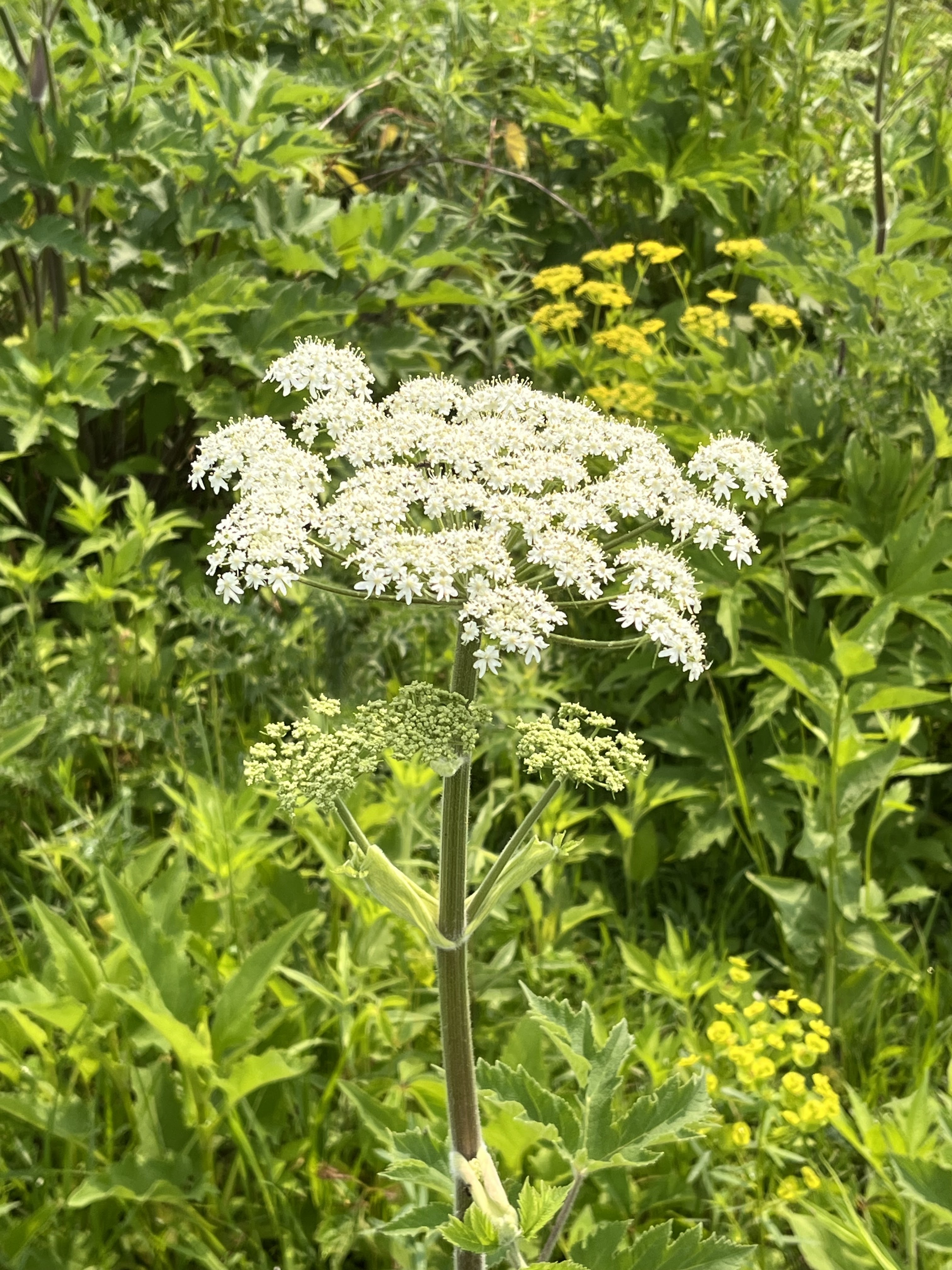
Cow Parsnip (Heracleum maximum)
Cow Parsnip
Cow parsnip, or Heracleum maximum, is a wildflower native to North America, including Wisconsin. It can reach heights of 4 to 10 feet. It bears large, flat-topped clusters of small white flowers, with each cluster—or umbel—spanning 4 to 12 inches across. Each tiny flower is about a quarter inch wide, with larger ones often framing the edges of the cluster in a lacy display. Its leaves are massive and divided into three parts, with the largest basal leaves stretching up to 18 inches long and wide; their surfaces are softly hairy and toothed at the edges. The stem is thick, hollow, ridged, and covered in fine white hairs, measuring up to 2 inches in diameter. This plant thrives in full sun to partial shade and prefers moist soils, commonly growing along streambanks, forest edges, and damp meadows. While striking, cow parsnip contains sap that can irritate the skin when exposed to sunlight—making it beautiful but best admired at a respectful distance. Beyond its striking appearance, cow parsnip plays a key ecological role by supporting pollinators such as bees, butterflies, and beetles with its abundant nectar and pollen. (LS)