Showing posts sorted by date for query sumx. Sort by relevance Show all posts

Obedient Plant (Physostegia virginiana)


Obedient Plant

The obedient plant (Physostegia virginiana) typically grows to a height of three to four feet. Its flowers are tubular and resemble snapdragons, arranged in dense spikes, with each flower about 1 inch long. The colors range from pink to pale lilac. The leaves are lance-shaped, growing in opposite pairs along the stem, with each pair rotated 90 degrees from the previous one. They are about four to five inches long and one to two inches wide, with serrated edges. Obedient plants prefer full sun to partial shade and thrive in moist, well-drained soils. They are quite adaptable and can grow in a variety of soil types, including loam, clay, and rocky soils. Often found in wetlands, prairies, and meadows, they can tolerate both drought and poor drainage. 

Obedient plant is often misinterpreted. Its name stems not from passivity, but from a peculiar trait: when a flower spike is bent, it temporarily holds its new position, as if “obedient” to touch. Ecologically, Physostegia virginiana functions as a robust colonizer in moist, disturbed habitats—such as degraded prairies, wet meadows, and riparian margins. It spreads vigorously through rhizomes, forming dense clonal patches that can suppress competing vegetation. While not allelopathic in the strict chemical sense, its rapid expansion and shading can inhibit the germination and growth of less aggressive species, including some non-native invaders. In restoration contexts, its dominance may be transitional: once site conditions stabilize and native plant diversity increases, obedient plant often recedes, allowing a more balanced community to emerge. 

(sumx)


Wild Senna (Senna marilandica)


Wild Senna

Wild senna (Senna marilandica) is a Wisconsin native perennial that grows up to 6 feet tall and 3 feet wide. Its bright yellow flowers bloom in mid to late summer, forming in axillary racemes, with each flower about ¾ inch across. Pollination is primarily carried out by bumblebees and solitary bees. It is a bumblebee magnet. The compound, pinnate leaves bear four to eight pairs of ovate to elliptical leaflets, adding to its lush appearance. Wild senna thrives in full sun to partial shade and tolerates a wide range of soil types, including sandy and rocky soils. It is commonly found along woodland edges, open fields, thickets, and moist habitats such as riverbanks and wet prairies. Ecologically, it serves as a larval host for several sulphur butterflies and its seeds provide food for upland gamebirds like quail and dove, making it a valuable addition to native plantings and restoration projects. 

(sumx)


Nodding Onion (Allium cernuum)


Nodding Onion

Nodding onion (Allium cernuum) is a Wisconsin native, perennial wildflower. It typically grows to a height of 12 to 18 inches. Its small flowers, about 1/4 to 1/2 inch in diameter, form in clusters that nod or droop, and are usually pink to lavender in color. Each cluster can have up to 30 individual flowers. The leaves are long, slender, and grass-like, measuring 6 to 12 inches in length and about 1/8 to 1/4 inch in width. They grow from the base of the plant and have a smooth texture. Nodding onion is commonly found in prairies, open woods, and rocky slopes, preferring well-drained soils and areas with full sun to partial shade, and is hardy in USDA zones 4 through 8. 

Nodding onion grows from a bulb and forms clumps over time. It blooms in mid to late summer and can be propagated either by seed or by dividing bulbs and offsets in spring or fall. Seeds require cold stratification to germinate successfully. Maintenance is minimal, though removing spent flower heads can help control self-seeding if desired. The bulbs, leaves, and flower stalks are edible, though they have a strong, bitter flavor. Indigenous peoples have used the plant for both food and medicinal purposes. Its name comes from the distinctive drooping habit of its flower clusters.

(sumx)


American Potato Bean (Apios americana)


American Potato Bean (Apios americana)

American potato bean is a perennial wildflower that is native to Wisconsin, where it blooms from July to September. It is a vine that can grow eight to ten feet long in here in this state, even longer in warmer climates. The flowers are composed of dense racemes of pink, purple, or red brown flowers. The flowers are about an inch long, and the racemes grow three to five inches long. The leaves are pinnate with five to seven leaflets, each three to six inches long. The alternate leaves can be either smooth or hairy, lanceolate in shape, and smooth along the edges. It prefers soil that is sandy loam, well-draining, and rich in organic matter. It can be found in moist woods, along river banks, moist meadows, and wet ravines. 

American potato bean, plays a valuable ecological role in native landscapes. As a legume, it enriches soil through nitrogen fixation, reducing the need for synthetic fertilizers and supporting surrounding plant communities. Its fragrant, pea-like flowers attract native pollinators, particularly leafcutting bees, and may also draw in flies. The plant serves as a larval host for the silver-spotted skipper, contributing to butterfly life cycles. Its foliage is browsed by deer, offering forage that’s elevated above parasite-prone ground vegetation. With its perennial, rhizomatous growth, it helps stabilize soil and prevent erosion, especially in riparian zones and disturbed habitats.

Cultivating it involves propagation by tubers, which resemble beads on a string, though diploid varieties can be grown from seed with patience. It thrives in consistently moist, slightly acidic to neutral soil and benefits from mulching to retain moisture. In cooler climates, full sun is ideal, while partial shade suits hotter zones. The long vines require trellising to prevent smothering nearby plants. Tubers are best harvested after frost, when their flavor improves, and can be stored in moist soil for spring planting. Rich in protein, iron, and calcium, the tubers are edible when cooked and can be roasted, mashed, or turned into flour. While all parts are technically edible, some individuals may experience digestive discomfort unless thoroughly cooked. The plant grows slowly, often taking two years to produce harvestable tubers, and its scattered rhizomes make digging a challenge. 

(sumx) 

Common Agrimony (Agrimonia gryposepala)


Common agrimony (Agrimonia gryposepala) is a perennial, Wisconsin native wildflower that can grow between 1 to 5 feet in height. It features small, bright yellow flowers arranged in elongating spike-like racemes at the top of the stem and arising from upper leaf axils. Each flower is about ¼ to ⅓ inch across, with five oval yellow petals and five to ten yellow stamens. The flowers are accompanied by green sepals that are pointed at the tip and slightly shorter than the petals. The leaves are compound, with 3 to 9 major leaflets and 1 to 4 pairs of smaller leaflets in between. The end leaflet is the largest, ranging from 1 to 4 inches long and ½ to 2 inches wide, becoming smaller towards the base of the compound leaf. The leaflets are elliptic to somewhat diamond-shaped, coarsely toothed with blunt to pointed teeth. The upper surface of the leaflets is hairless or nearly so, while the lower surface is densely covered in short, glandular hairs with sparse, long, non-glandular hairs mostly along the veins. 

It thrives in various habitats, including open woods, woodland edges, thickets, fields, and swamps. It blooms from mid to late summer, typically July through September, and its flowers are mildly fragrant, attracting a variety of pollinators including bees, butterflies, and beetles. After flowering, the plant produces small, burr-like fruits with hooked bristles that cling to fur and clothing, aiding in seed dispersal.

(sumx)


Wild Germander (Teucrium canadense)


Wild Germander

Wild germander (Teucrium canadense) is a native perennial wildflower in Wisconsin that grows up to three feet tall. It features a four-sided, hairy stem that is rarely branched. It produces a terminal spike of 3/4 inch long, purplish-pink flowers. The flowers have a unique corolla configuration with no apparent upper lip. It has opposite leaves that can be up to five inches long and 2-1/2 inches wide. The upper leaf surface is dark green with recessed veins and the lower leaf surface is dull green with raised veins. Wild Germander thrives in fields, prairies, low woods, stream sides, roadsides, and other disturbed sites.

This plant belongs to the mint family and is widespread across much of North America. Its square stems and opposite leaves are typical of mint relatives, and its flowers bloom from June to September. Each flower has a broad lower lip that serves as a landing pad for pollinators such as bees, butterflies, and flies. The upper lip is nearly absent, but four long stamens arch outward through a slit, giving the flower a distinctive appearance that resembles an orchid when viewed head-on.

Wild germander spreads through rhizomes, forming colonies in suitable habitats. Its root system is fibrous, and the plant can tolerate a range of soil types, though it prefers moist to medium-moist conditions. It is hardy in USDA zones 4 through 9 and can grow in full sun or partial shade. While the flowers are visually striking, they lack fragrance. After blooming, each flower produces four small seeds enclosed in a persistent calyx.

Historically, Native Americans used wild germander for medicinal purposes. The leaves were steeped in water to treat skin sores and ulcers, and teas were made for various ailments. However, modern herbal use has declined due to concerns about liver toxicity associated with certain compounds found in the plant. Despite this, it remains an important species for pollinators and is often included in native plant gardens and restoration projects.

(sumx)

Rosinweed (Silphium integrifolium)


Rosinweed is a native, perennial wildflower in Wisconsin. It typically grows between 3 to 6 feet tall and features bright yellow flowers that resemble sunflowers. The flower heads measure up to three inches in diameter. The leaves of rosinweed are quite distinctive. They are large, rough, and stalkless, growing in pairs along the stem. Each leaf can be up to 8 inches long and is lance-shaped to ovate. The plant is named for the sticky, resinous sap that oozes from cut or broken stems. It can be found in prairies, glades, and roadsides. Rosinweed thrives in a variety of soil conditions, from moderately dry to moist, and is well-suited to tough clay soils. It prefers full sunlight but can tolerate partial shade, and once established, it is drought tolerant.

In addition to its hardiness, rosinweed offers important ecological benefits: its long-blooming flowers provide nectar and pollen for bees, butterflies, and beetles, while its seeds are a valuable food source for birds such as finches. Rosinweed also supports caterpillars of the rosinweed moth. The plant’s deep taproots help stabilize soil and improve water infiltration, making it a useful species for erosion control and prairie restoration. 

(sumx)


Swamp Milkweed (Asclepias incarnata)


Swamp Milkweed (Asclepias incarnata)


Swamp milkweed is a native, perennial wildflower in Wisconsin. It typically grows three to five feet tall. The flowers bloom in shades of pink, mauve, or occasionally white. Each individual flower is about 1/4 inch in diameter, but they are arranged in clusters that can be two to three inches in diameter. Lance shaped leaves grow in pairs along the stem. They are three to six inches long and one to two inches wide. This plant prefers moist to wet soils and is often found in wetlands, along streams, and in wet meadows. It thrives in full sun, but it can tolerate partial shade.


Ecologically, it plays a vital role as a host for monarch butterflies, providing both a nursery for caterpillars and a nectar source for adults, while also attracting bees, hummingbirds, and other butterflies. It adapts to garden soils with adequate watering and is hardy across much of the Midwest. In addition to its ornamental use, swamp milkweed resists deer browsing and tolerates heavy clay soil, making it suitable for rain gardens and naturalized borders. It spreads slowly via underground rhizomes and can be propagated by seed—though successful germination typically requires a chilling period to mimic winter dormancy. Historically, its fibers were used for twine and buoyant stuffing, and some Indigenous groups employed it medicinally for respiratory issues. While beautiful and ecologically beneficial, it contains cardiac glycosides that are toxic if ingested in quantity. 


(sumx)


Glade-mallow (Napaea dioica)


Glade Mallow

Glade mallow (Napaea dioica) is a tall, flowering plant native to Wisconsin that can grow anywhere from five to ten feet high. It grows in the moist, rich soils of floodplains, stream edges, and open woodlands, preferring full to partial sunlight. Its large, palmately lobed leaves can reach 18 inches across, giving the plant a lush, almost tropical appearance that stands out in its natural habitat.

The flowers of glade mallow are relatively small—about a third to three-quarters of an inch in diameter—but they are numerous. Each white bloom has five petals and five sepals, and they grow in branched clusters called panicles. Because the plant is dioecious, individual plants bear either male or female flowers. Male blossoms showcase a column of pink-tipped stamens, while female flowers have slender styles atop a rounded ovary. These delicate flowers open with the morning light and close by evening, attracting a variety of pollinators during the blooming season from June through August.

Additionally, glade mallow  plays a role in native plant communities. It often forms colonies through its rhizomes, creating dense stands that provide shelter and habitat for wildlife. Female plants produce small, segmented seed clusters called schizocarps, which help propagate the species in favorable conditions. Though hardy in the right setting, Glade mallow is threatened in parts of its range due to habitat loss and reduced wetland areas, making it a candidate for conservation efforts. Gardeners who wish to grow it successfully should mimic its natural environment—offering moisture-retentive soil, ample sunlight, and enough space for its towering stems and generous foliage.

(sumx)


Pale Purple Coneflower (Echinacea pallida)


Pale Purple Coneflower (Echinacea pallida) 

Pale purple coneflower (Echinacea pallida) is a perennial wildflower native to central North America. It grows up to about three feet tall and bears distinctive flowers with a reddish‑brown, elongating central cone surrounded by long, slender, drooping ray florets ranging from pale pink to purple. The leaves are lanceolate, rough on both sides, and concentrated mostly along the lower portion of the stem. This species thrives in dry to mesic prairies, open woodlands, glades, and roadsides, favoring full sun and well‑drained soils.

Ecologically, pale purple coneflower supports a variety of pollinators. Bumblebees, solitary bees, butterflies, and skippers frequently visit its blooms. Larvae of the silvery checkerspot butterfly may feed on Echinacea foliage, though the species is not an exclusive host. As the growing season progresses, the plant produces tan achenes that can provide food for birds if the seed heads are left standing.

In restoration and garden settings, Echinacea pallida is valued for its drought tolerance and distinctive early‑summer bloom period. It can be propagated from seed, though flowering typically requires two to three years. Seeds benefit from cold stratification or fall sowing to ensure germination. Once established, the plant requires little maintenance and may self‑seed if conditions are suitable. Because it forms a deep taproot, it is not well suited to division.

Beyond its ecological functions, pale purple coneflower has a long history of cultural and medicinal use. Indigenous peoples used its roots for treating bites and infections, and it remains valued in herbal traditions for its reputed immune‑supporting properties.

Sources:

USDA PLANTS Database — Echinacea pallida

Lady Bird Johnson Wildflower Center — Echinacea pallida

Missouri Botanical Garden — Echinacea pallida

Illinois Wildflowers — Echinacea pallida

Grokipedia — Echinacea pallida

(sumx) 


Cylindrical Thimbleweed (Anemone cylindrica)


Cylindrical Thimbleweed 
 

Cylindrical thimbleweed (Anemone cylindrica) is a native, perennial wildflower in Wisconsin. It grows one to three feet tall. The flowers are greenish white and about 3/4 inch across. Each flower has five petal-like sepals and numerous yellow stamens surrounding a green, cone-like center. The leaves are palmately compound. Each leaflet can be up to four inches long and is deeply lobed, hairy, and wedge shaped at the base. The basal leaves are larger and have long stalks, while the stem leaves are smaller.

This wildflower prefers open habitats such as dry prairies, woodland margins, roadsides, and savannas, thriving in sandy or gritty soils where it’s unlikely to compete with taller, more aggressive species. It tolerates drought well and plays a modest but meaningful role in native ecosystems. Small bees and hoverflies are drawn to its pollen, while the unique seed heads contribute visual interest in the colder months and aid in wind dispersal.

Cylindrical thimbleweed contains protoanemonin, a compound common to the Ranunculaceae family that helps deter herbivores and inhibit the germination of surrounding plants. Though not especially competitive, this subtle chemical advantage reinforces its ability to hold space in sparse environments. For gardeners and restorationists, it’s an ideal candidate for dry native plant gardens. Its seeds require cold stratification to break dormancy, and while the plant isn’t aggressive, it does spread slowly by rhizomes. 

(sumx)


Rattlesnake Master ( Eryngium yuccifolium)


Rattlesnake master (Eryngium yuccifolium) 


Rattlesnake master (Eryngium yuccifolium) typically grows 3 to 5 feet tall and spreads about 1 to 2 feet wide. Its distinctive flower heads form tight, ball‑like clusters of greenish‑white blooms that resemble thistles, though the plant belongs to the carrot family. Each flower head is composed of many small, densely packed florets surrounded by pointed, spiny bracts. The leaves are long, narrow, and sword‑shaped, blue‑green in color, with parallel veins and stiff spines along the margins.

This species thrives in full sun and is found in prairies, glades, open meadows, and the edges of rocky woodlands, preferring dry, sandy, or well‑drained soils. Its deep taproot provides strong drought tolerance and helps stabilize soil.

Ecologically, rattlesnake master supports a wide range of pollinators. Bees, butterflies, and beneficial wasps visit its dense flower clusters throughout mid to late summer, making it an important nectar source during that period. In horticultural settings, its architectural foliage and unusual flower heads add texture and contrast to native plant gardens. Its drought tolerance, low maintenance needs, and resistance to deer browsing make it a reliable choice for sustainable landscaping and restoration projects.

Sources:

USDA PLANTS Database — Eryngium yuccifolium

Lady Bird Johnson Wildflower Center — Eryngium yuccifolium

Missouri Botanical Garden — Eryngium yuccifolium

Illinois Wildflowers — Eryngium yuccifolium

Grokipedia — Eryngium yuccifolium

(sumx)

Eastern Prickly Pear Cactus (Opuntia humifusa)


Eastern Prickly Pear Cactus (Opuntia cespitosa)

Nestled in Wisconsin’s sunlit glades and rocky slopes, the Eastern Prickly Pear Cactus (Opuntia cespitosa) is a native, perennial found in dry habitats. Rising just six to twelve inches tall and spreading in dense, turf-like clumps up to eighteen inches wide, this cespitose species forms mats of resilient pads that store water and perform photosynthesis—adaptations finely tuned to endure heat, drought, and cold winters down to USDA Zone 4.

Most specimens are well-armed: sharp, pale spines and reddish-brown glochids emerge from areoles like miniature warnings, though a few may appear deceptively soft. These glochids—barbed hairs so fine they evade sight—can irritate skin and linger long after contact, offering potent defense.

In June and July, O. cespitosa bursts into waxy yellow blooms with vivid red or orange centers—a molten eye glowing above sandy soils. Each flower lives just one day, yet draws a parade of pollinators: bumble bees, carpenter bees, butterflies, and skippers. It also hosts specialist moths such as the Arge Tiger and Julia’s Dicymolomia, adding motion and memory to the cactus’s brief floral display.

Thriving in full sun and well-drained, slightly acidic sandy or rocky soils, this cactus is adapted to glades, barrens, and prairie edges where few others dare root. Its reddish-brown fruits—known as tunas—are club-shaped and edible, offering moisture and nutrition to wildlife. While slow to expand, O. cespitosa reproduces clonally: detached pads settle into place and root quietly, a gesture of persistence rather than conquest.

Though long considered a variant of O. humifusa, O. cespitosa stands distinct—its floral centers and growth habit marking it as a tenacious resident of the Midwest’s overlooked margins. 

(sumx)

Clasping Milkweed (Asclepias amplexicaulis)


Clasping Milkweed (Asclepias amplexicaulis)
Photo by Leticia Provencio

Clasping milkweed is a native, perennial wildflower in Wisconsin. It grows one to three feet tall. The flowers have a soft pink hue, often washed with cream or green. The flower structure is complex: each rounded cluster is two to four inches in diameter, with five reflexed petals and five hood‑like structures above them. The leaves are opposite, waxy, and oval, three to five inches long and about two inches wide, with bases that clasp the stem. This species grows in dry habitats such as sandhills, dry open woods, pine savannas, and fallow fields. It performs best in full sun but tolerates partial shade.

Ecologically, clasping milkweed provides nectar and pollen for a variety of native bees and butterflies adapted to sandy, open habitats. Although many milkweeds serve as larval hosts for monarch butterflies, A. amplexicaulis is not a confirmed monarch host plant. Its drought tolerance and preference for sandy soils make it a suitable choice for native plant gardens and prairie‑style landscapes where well‑drained soils are present.

Sources:

NatureServe Explorer — Asclepias amplexicaulis

Wikipedia — Asclepias amplexicaulis

Native Wildflowers of Wisconsin — Clasping Milkweed (Asclepias amplexicaulis)

FSUS / North Carolina Botanical Garden — Asclepias amplexicaulis

Grokipedia — Asclepias amplexicaulis

(sumx)


Butterfly Milkweed (Asclepias tuberosa)


Butterfly Milkweed (Asclepias tuberosa)

Butterfly milkweed is a perennial wildflower native to Wisconsin and much of eastern and central North America. It typically grows one to two feet tall and forms a compact, upright clump topped with bright orange to yellow‑orange flower clusters. These clusters are usually two to five inches across and appear at the ends of the stems in early to midsummer. Each flower has the characteristic milkweed structure, with a five‑part crown, though the blossoms are smaller and more densely arranged than those of common milkweed.

The leaves are stiff, dark green, and lance‑shaped, ranging from two to six inches long. They are toothless, alternate or sometimes spirally arranged, and attached to stems that are also firm and hairless or only lightly hairy. Unlike most other milkweeds, butterfly milkweed does not produce milky sap; instead, it exudes a clear sap when cut, a trait that often surprises people familiar with the genus.

This species grows best in full sun and well‑drained soils, including sand, loam, clay, and even limestone‑derived substrates. Once established, it is highly drought‑tolerant thanks to a deep, woody taproot. Its tidy form and resilience make it a reliable choice for native gardens, prairie restorations, and sunny roadside plantings, especially in Wisconsin’s variable summer conditions.

Ecologically, butterfly milkweed is an important nectar source for butterflies, bees, and other pollinators. Monarch butterflies lay their eggs on it, and the caterpillars feed on its foliage just as they do with other milkweed species. Its long bloom period and abundant nectar make it one of the most visited milkweeds in prairie landscapes.

Sources:

Lady Bird Johnson Wildflower Center — Asclepias tuberosa Illinois Wildflowers — Asclepias tuberosa (Butterfly Milkweed) Minnesota Wildflowers — Asclepias tuberosa USDA NRCS Plants Database — Asclepias tuberosa Wisconsin State Herbarium — Asclepias tuberosa

(sumx)   

Twin-flower (Linnaea borealis)


Twin-flower (Linnaea borealis) grows to a height of three to six inches. The ½-inch long, pink bell flowers grow in pairs. Each flower has five fused petals. The leaves are round, ½ inch wide, and toothless. They can be found in conifer woodlands in the northern half of Wisconsin.

This delicate, evergreen groundcover is a hallmark of boreal and sub-boreal forests across the Northern Hemisphere. Its paired, nodding flowers—borne on slender Y-shaped stalks—emit a sweet fragrance and typically bloom for about a week in June or July. The plant’s name, borealis, reflects its northern distribution, while the genus Linnaea honors Carl Linnaeus, the father of modern taxonomy, who regarded this plant with particular affection.

Linnaea borealis spreads through trailing runners that weave loosely across the forest floor, often mingling with mosses and leaf litter beneath conifers like spruce, fir, and pine. The evergreen leaves, arranged in opposite pairs along the stem, echo the plant’s theme of symmetry. Though unassuming when not flowering, it becomes a quiet spectacle in bloom, a fleeting adornment of the woodland understory.

Ecologically, Twin-flower favors cool, moist, acidic soils and often appears in mature, undisturbed forests. Its presence can signal relatively intact woodland ecosystems. While it’s not a dominant nectar source, its blossoms do attract small pollinators, and its creeping growth helps stabilize soil and enhance the structure of the understory. 

(sumx)

Ghost Plant (Monotropa uniflora)


Ghost Plant (Monotropa uniflora) 

Ghost plant is a native wildflower found across eastern North America, including Wisconsin. It is instantly recognizable for its pale, waxy, almost translucent appearance. Lacking chlorophyll, it is not green like typical plants but instead emerges as a white or grayish stem one to ten inches tall, often with a faint pink or blackish tint as it ages. Each stem bears a single nodding flower at the tip, giving the plant its characteristic pipe‑like shape when young. As the flower matures and sets seed, the stem straightens and the bloom becomes upright.

The plant’s leaves are reduced to small, scale‑like structures that cling to the stem, reflecting its unusual lifestyle. Ghost plant is not photosynthetic; instead, it is a mycoheterotroph, drawing its nutrients from fungi in the soil. Those fungi, in turn, are connected to nearby trees through mycorrhizal networks. This three‑way relationship means ghost plant grows only where the right fungal partners and forest conditions exist. It is most often found in rich, moist, shaded woodlands, especially under beech, maple, or pine, and typically appears after periods of rain in summer.

The flowers are about half an inch long, with four or five petals that open slightly as the plant matures. Their color shifts from white to gray or even black as they age or dry. After pollination—often by small bees—the flower produces a capsule filled with tiny seeds that are dispersed by wind. Because the plant relies entirely on its fungal partners, it cannot be transplanted or cultivated and disappears quickly if the surrounding forest is disturbed.

Ghost plant often grows in small clusters, though individual stems may appear scattered across the forest floor. Its eerie, luminous quality makes it a memorable sight for hikers, and its presence signals a healthy, intact woodland with a functioning fungal community.

Source list (plain text):

Illinois Wildflowers — Monotropa uniflora (Indian Pipe) Minnesota Wildflowers — Monotropa uniflora Lady Bird Johnson Wildflower Center — Monotropa uniflora USDA NRCS Plants Database — Monotropa uniflora Wisconsin State Herbarium — Monotropa uniflora

(sumx)

False Sunflower (Heliopsis helianthoides)


False Sunflower 

False sunflower (Heliopsis helianthoides) is a perennial wildflower native to eastern North America, including Wisconsin. Reaching heights of three to six feet, it stands tall in grasslands and along woodland edges, where it thrives in full sun and well-drained soil. Its daisy-like flowers are a standout feature—bright yellow petals encircle a golden-brown, cone-shaped center disk, creating a display that measures two to three inches across.

The foliage of false sunflower is equally distinctive. Its ovate leaves grow in opposite pairs along the stem and can reach up to six inches in length. The leaf margins are toothed, and the surface has a rough, sandpapery texture that helps deter browsing animals like deer and rabbits. These sturdy stems and coarse leaves support a long blooming season, typically stretching from early summer into fall.

False sunflower also plays an important ecological role. It attracts a wide range of pollinators, including bees and butterflies, and its seeds provide food for birds later in the season. The plant’s deep roots also help stabilize soil, making it a valuable addition to restoration projects and native plant gardens.

(sumx)


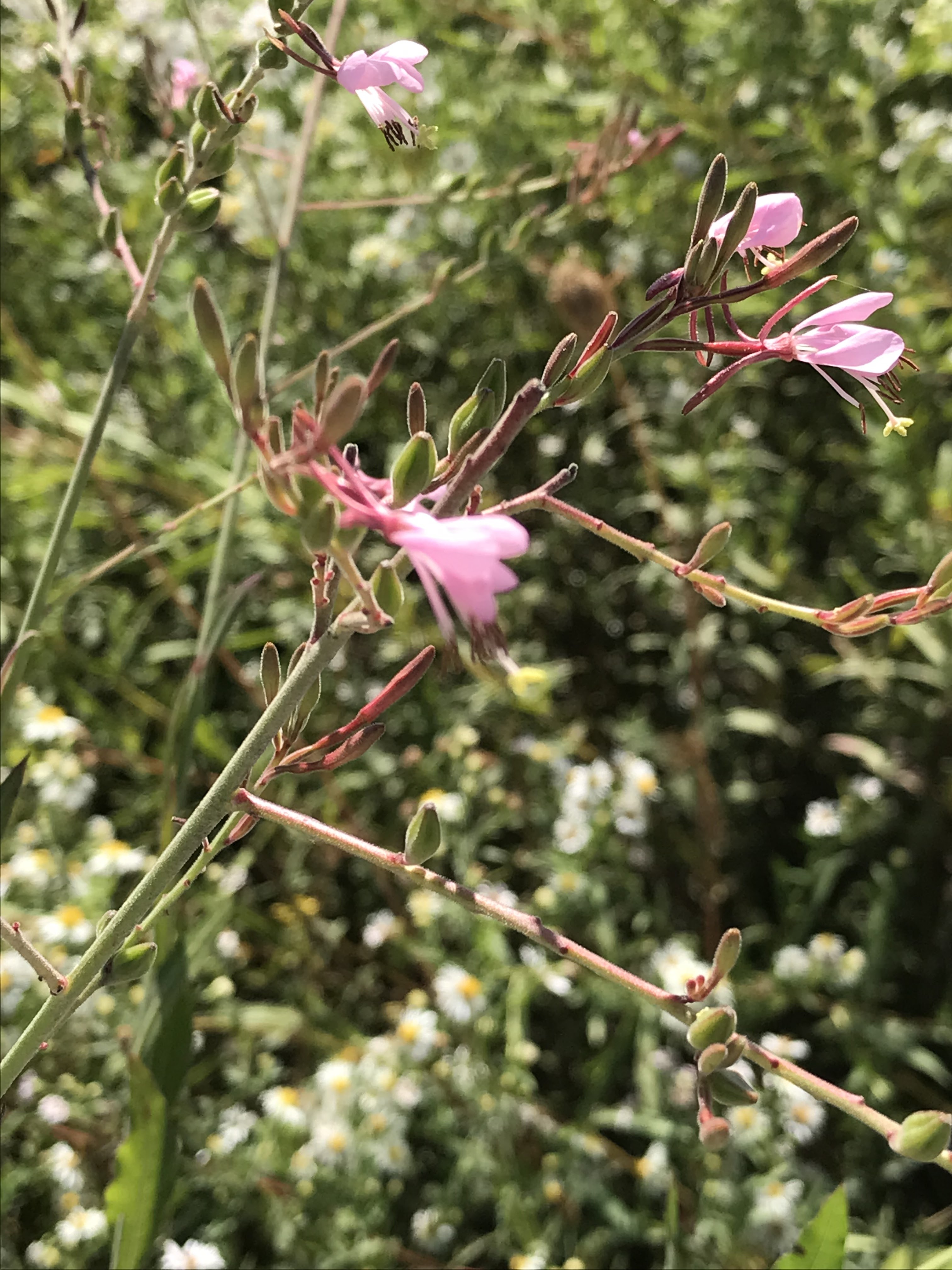
Biennial Gaura (Oenothera gaura)


Biennial Gaura

Biennial gaura (Oenothera gaura) is a native, biennial wildflower in Wisconsin, belonging to the evening primrose family. It commonly grows in woodlands, streambanks, disturbed areas, open fields, and roadsides, thriving in habitats ranging from moist to dry. This species plays an important ecological role as a pioneer plant, helping stabilize soil and support biodiversity in recovering ecosystems.

Biennial gaura  typically reaches four to six feet tall, with slender, branching stems that may have a reddish or purplish tint, especially toward the top. The roots form a strong taproot, allowing it to tolerate drought and anchor into challenging soil conditions.

Its flowers are white fading to pinkish, with delicate fan-like petals, and bloom from mid to late summer into early fall, making it a valuable nectar source for bees, butterflies, and moths during a time when few native plants are in flower. After blooming, it produces small, dry fruits (achenes) that are dispersed by wind or gravity.

The leaves are rough and oriented vertically, When fully grown, they are about five inches long and 1½ inches wide. Leaves typically alternate along the stems, though occasionally whorled arrangements occur where new stems emerge from old ones. Leaf shapes range from lanceolate to ovate, with smooth to slightly dentate margins, and are hairy on both surfaces, aiding in moisture retention and resilience. 

Sources:

Flora of North America — Oenothera gaura

Wisconsin State Herbarium — Oenothera gaura (Gaura biennis)

Illinois Wildflowers — Biennial Gaura (Gaura biennis)

USDA NRCS PLANTS Database — Oenothera gaura

Minnesota Wildflowers — Biennial Gaura (Oenothera gaura)

Lady Bird Johnson Wildflower Center — Oenothera gaura

Missouri Botanical Garden Plant Finder — Oenothera gaura (Gaura biennis)

(sumx)

American Waterlilly (Nymphaea odorata)


     The American Waterlily is a native, perennial in Wisconsin. The floating water flowers, three to six inches wide, are made of many pointed petals surrounding a yellow center. The floating leaves are round or heart-shaped, deeply notched, toothless, shiny green. They grow up to 10 inches across. It grows in ponds and lakes.  

(sumx)